


What is a 403b Rollover and How Does It Work?
Understanding the 403b rollover pros — and the cons — can be the difference between a comfortable retirement and leaving tens of thousands of dollars on the table.
If you’re mid-career and wondering whether to move your 403(b) into an IRA or a new employer’s plan, here’s a quick summary of the key advantages:
- Lower fees — Rolling into an IRA can cut expense ratios from 2.21% down to as low as 0.15%, a difference that can add up to over $500,000 in savings over a career
- More investment choices — Employer plans often limit you to fewer than 10 options; IRAs open the door to thousands of funds, ETFs, and stocks
- Account consolidation — Merging scattered retirement accounts into one place makes tracking and managing your portfolio far simpler
- Potential for tax-free growth — Rolling into a Roth IRA (if you meet the rules) means qualified withdrawals in retirement are completely tax-free
- Greater flexibility — IRAs typically offer more withdrawal options and estate planning benefits than employer-sponsored plans
That said, rollovers aren’t always the right move. You can lose access to penalty-free withdrawals at age 55, face surrender fees on annuity contracts, and owe taxes upfront on Roth conversions. The details matter a lot.
This guide breaks down everything — fees, tax rules, timing, paperwork, and the traps most people don’t see coming — so you can make a confident, informed decision.
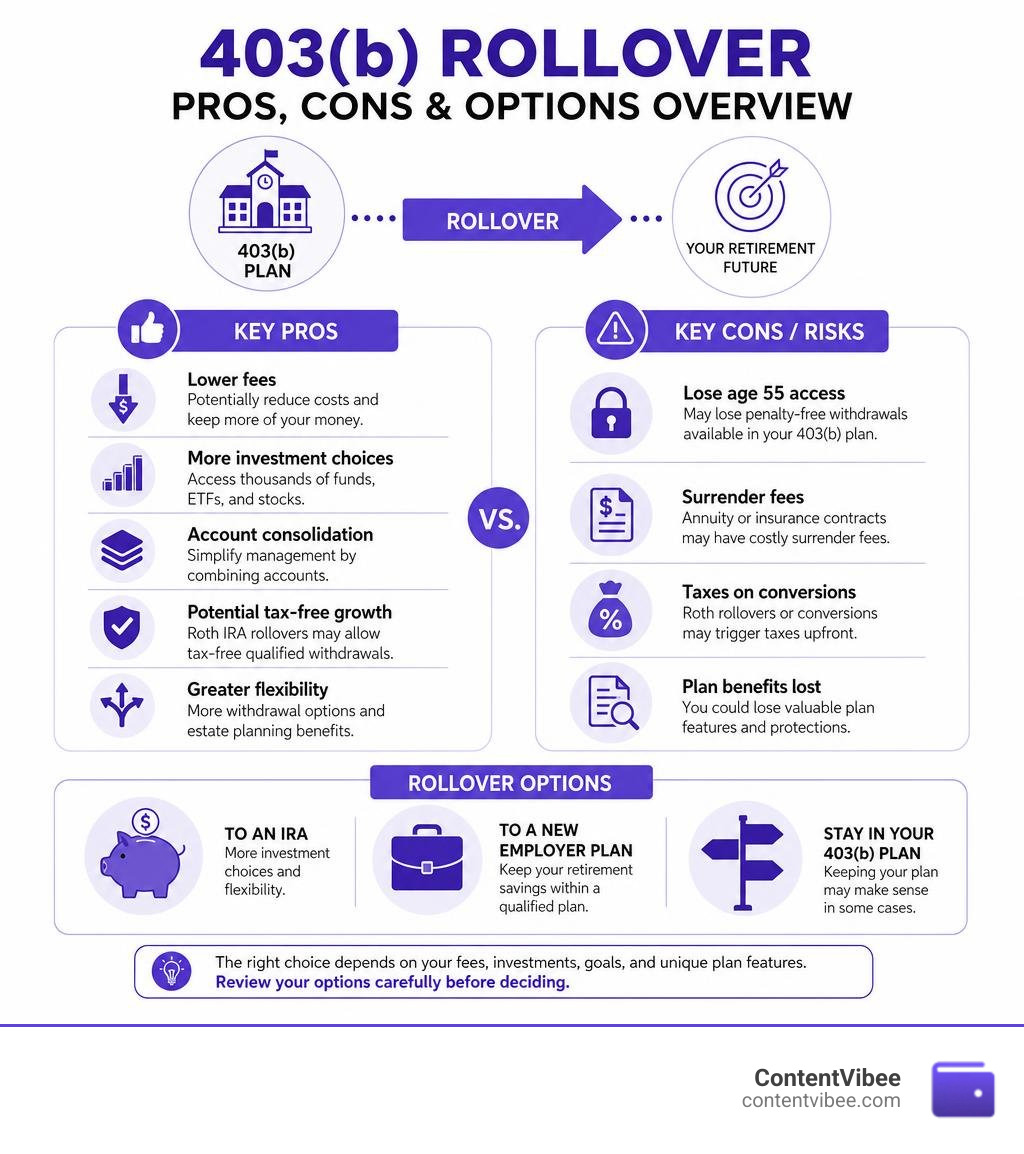
At its core, a 403(b) rollover is the process of moving your retirement savings from a 403(b) plan—typically offered by public schools, universities, hospitals, and 501(c)(3) nonprofits—into another qualified retirement account. This could be an Individual Retirement Account (IRA) or a new employer’s 401(k) or 403(b) plan.
The primary goal of a rollover is to keep your money growing under a tax-advantaged umbrella without triggering immediate income taxes or early withdrawal penalties. When done correctly, the money moves smoothly from one custodian to another. However, if you make a misstep, the IRS is waiting to treat your hard-earned savings as a taxable distribution.
To master this transition and avoid expensive pitfalls, we recommend checking out our comprehensive 403b Rollover Guide: Master Your Retirement Account Move.
Direct vs. Indirect Rollover Methods
When you decide to move your funds, you must choose between two distinct pathways: a direct rollover or an indirect rollover.
- Direct Rollover (Trustee-to-Trustee Transfer): This is the gold standard of retirement account moves. In a direct rollover, the financial institution holding your 403(b) sends the funds directly to your new IRA custodian or your new employer’s plan administrator. The money never touches your personal bank account, meaning there is zero risk of triggering tax withholding or IRS penalties.
- Indirect Rollover (The 60-Day Withholding Trap): In an indirect rollover, the custodian of your old 403(b) cuts a check made payable directly to you. From the day those funds are distributed, you have exactly 60 days to deposit the entire balance into a new tax-advantaged account.
The major catch with an indirect rollover is the mandatory 20% federal tax withholding. If your 403(b) balance is $100,000, your old provider will withhold $20,000 for taxes and send you a check for only $80,000. To complete the rollover and avoid taxes and a 10% early withdrawal penalty on the withheld portion, you must deposit the full $100,000 into your new account within 60 days. This means you must come up with $20,000 of your own cash to bridge the gap until you file your tax return and claim the withheld funds back.
To help visualize these paths, refer to the official IRS Rollover Chart to see which accounts can accept your 403(b) funds.
| Feature | Direct Rollover | Indirect Rollover |
|---|---|---|
| Who receives the check? | The new custodian (FBO you) | You personally |
| Tax Withholding | 0% | 20% mandatory federal withholding |
| Time Limit | None (completed automatically) | Must be deposited within 60 days |
| IRS Penalties | None | 10% early withdrawal penalty if 60-day window is missed |
| Frequency Limits | Unlimited | Restricted to one per 12-month period |
Weighing the 403b Rollover Pros and Cons
Is moving your money the right strategic decision for your financial future? For many public sector and nonprofit employees, the answer is a resounding yes. However, making the move requires balancing the immediate benefits against potential drawbacks.
To dive deeper into the emotional and financial steps of leaving an old plan behind, read our guide on Breaking Up with Your Employer: How to Roll a 403b into an IRA.
The Major 403b Rollover Pros for Your Portfolio
The most compelling argument for a rollover lies in the 403b rollover pros, particularly when moving your funds into a traditional or Roth IRA.
First, consider the investment selection. Traditional 403(b) plans are notorious for offering a highly restricted menu of investment choices—often fewer than 10 mutual funds or variable annuities chosen by your employer. By rolling those funds into an IRA, you gain access to a virtually limitless universe of individual stocks, low-cost Exchange-Traded Funds (ETFs), mutual funds, and even alternative assets.
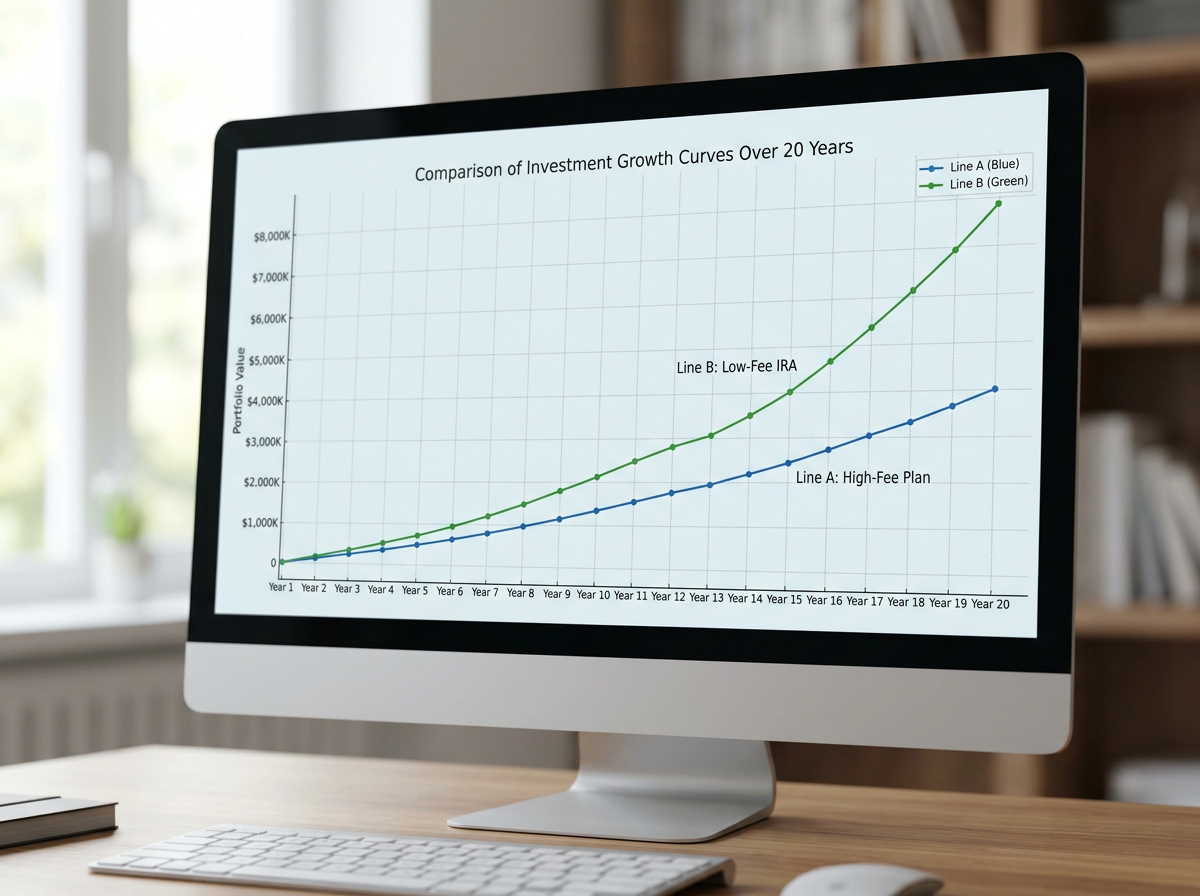
Second, let’s talk about fees. Many 403(b) plans are packed with administrative wrap fees, recordkeeping charges, and high expense ratios. In fact, a 1% difference in annual fees can result in more than $500,000 less in retirement savings over a career.
For example, if you leave a $10,000 balance in an old employer’s plan with a 2.21% expense ratio, you are paying roughly $1,082 per year in fees. By rolling those funds into a self-directed IRA at an institution like Vanguard, where a target-date fund might carry an expense ratio of just 0.15%, your annual cost drops to a mere $15. To learn how to execute this specific fee-saving move, take a look at our Step-by-Step Guide to Moving Your 403b to Vanguard.
Finally, consolidation simplifies your life. The average worker changes jobs multiple times throughout their career, leading to scattered, forgotten accounts. Bringing those balances under one roof makes tracking your asset allocation, managing passwords, and planning your distributions infinitely easier.
Potential Cons of Moving Your Retirement Savings
Despite the clear benefits, there are valid reasons to keep your money where it is:
- Loss of the “Age 55 Rule”: If you leave your job in or after the calendar year you turn 55, the IRS allows you to take penalty-free withdrawals from your current employer’s 403(b) plan. If you roll those funds into an IRA, you generally must wait until age 59½ to access the money penalty-free, unless you qualify for an exception.
- Creditor Protection: Under federal law, ERISA-governed employer plans offer robust, unlimited protection against bankruptcy and civil lawsuits. IRAs are protected up to certain limits in bankruptcy, but civil creditor protections vary widely by state law.
- Surrender Charges: Many older 403(b) plans, particularly those built around variable annuities, carry steep surrender charges (sometimes up to 7% of the account value) if you try to move your money within a certain window.
- Outstanding Loans: If you have an active loan against your 403(b), rolling over the account will trigger a loan offset, turning the unpaid balance into a taxable distribution.
Rolling Over a 403b Into an IRA vs. a New Employer Plan
If you have decided that keeping your money in your old 403(b) is not the best path forward, you have two primary destinations to evaluate: an Individual Retirement Account (IRA) or your new employer’s retirement plan.
If you are leaning toward moving your savings to a new corporate plan, read our walkthrough on Moving On Up: The Step-by-Step Guide to a 403b to 401k Rollover.
Key 403b Rollover Pros When Choosing an IRA
Opting for an IRA gives you complete, independent control over your retirement destiny. You are no longer bound by the investment menu curated by an employer’s HR department.
Furthermore, if you choose a Self-Directed IRA (SDIRA), you can invest in alternative assets like physical precious metals, real estate, or private equity.
An IRA also frees you from the “annuity lockups” common in 403(b) plans. For instance, teachers and university staff with TIAA-CREF accounts often discover that their TIAA Traditional Annuity balances cannot be rolled over in a lump sum. Instead, they are subject to an 84-month (7-year) phased payout schedule unless they pay a 2.5% exit fee to leave within a 12-day window. Moving your liquid funds to an IRA prevents future lockups and gives you daily liquidity.
When a New Employer 401k or 403b Makes More Sense
Conversely, rolling your old 403(b) into your new employer’s 401(k) or 403(b) plan is highly beneficial in specific scenarios:
- You want loan access: IRAs do not allow you to take out loans. If you think you might need to borrow against your retirement savings, keeping your money in an active employer plan that permits loans is a major advantage.
- You want to avoid the Backdoor Roth IRA pro-rata rule: If you are a high earner who plans to use the Backdoor Roth IRA strategy, having a large pre-tax balance in a Traditional IRA will trigger the IRS pro-rata rule, making a portion of your conversion taxable. Keeping your pre-tax funds in an employer 401(k) or 403(b) keeps your Traditional IRA balance at zero, allowing tax-free Backdoor conversions.
- Higher Contribution Limits and Catch-Ups: For the 2026 tax year, the maximum contribution limit for a 403(b) or 401(k) is $24,500 (plus an $8,000 catch-up contribution for those age 50+). This is significantly higher than the 2026 IRA contribution limit of $8,000 (plus a $1,100 catch-up). To understand how these limits work, read The New 2026 Maximum 401k Contribution Limits Explained.
Converting a 403b to a Roth IRA: Tax Implications and Rules
If you are looking to maximize tax-free income in retirement, rolling your pre-tax 403(b) into a Roth IRA is an incredibly powerful strategy. However, this move is not a standard, tax-free rollover; it is a Roth conversion.
To understand the foundational rules of this move, check out Can You Move Your 403b to a Roth IRA?.
When you convert pre-tax 403(b) funds into a Roth IRA, you must pay ordinary income tax on every dollar converted in the tax year the conversion occurs. Once the money is inside the Roth IRA, it grows tax-deferred, and all qualified distributions in retirement are 100% tax-free.
Under the SECURE 2.0 Act, there are also new guidelines for high earners. Starting in 2026, if your FICA wages exceed $150,000, any catch-up contributions you make to an employer plan must be made on a Roth (after-tax) basis. This makes understanding Roth accounts more critical than ever.
Tax Math Behind a Roth Conversion
A Roth conversion makes the most sense when you believe you are currently in a lower tax bracket than you will be in during retirement.
For example, if you are currently in the 22% federal tax bracket and convert a $150,000 pre-tax 403(b) to a Roth IRA, you will face an upfront tax bill of roughly $33,000. However, if that money grows over the next 15 years to $490,000, you can withdraw the entire amount tax-free in retirement—saving you over $100,000 in future taxes if tax rates rise.
Before initiating a conversion, make sure you understand the contribution limits by reading The Ultimate Guide to Your 2026 Max Roth IRA Contribution and review our comprehensive conversion playbook, The Ultimate Guide to Converting Your 403b to a Roth IRA. That while IRS Publication 590-A outlines the federal rules, consulting a CPA is highly recommended to avoid accidentally pushing yourself into a higher tax bracket.
Step-by-Step Guide to Completing Your Rollover
Executing a successful rollover requires clear coordination between your old plan administrator and your new custodian. Follow this checklist to ensure a smooth, penalty-free transfer:
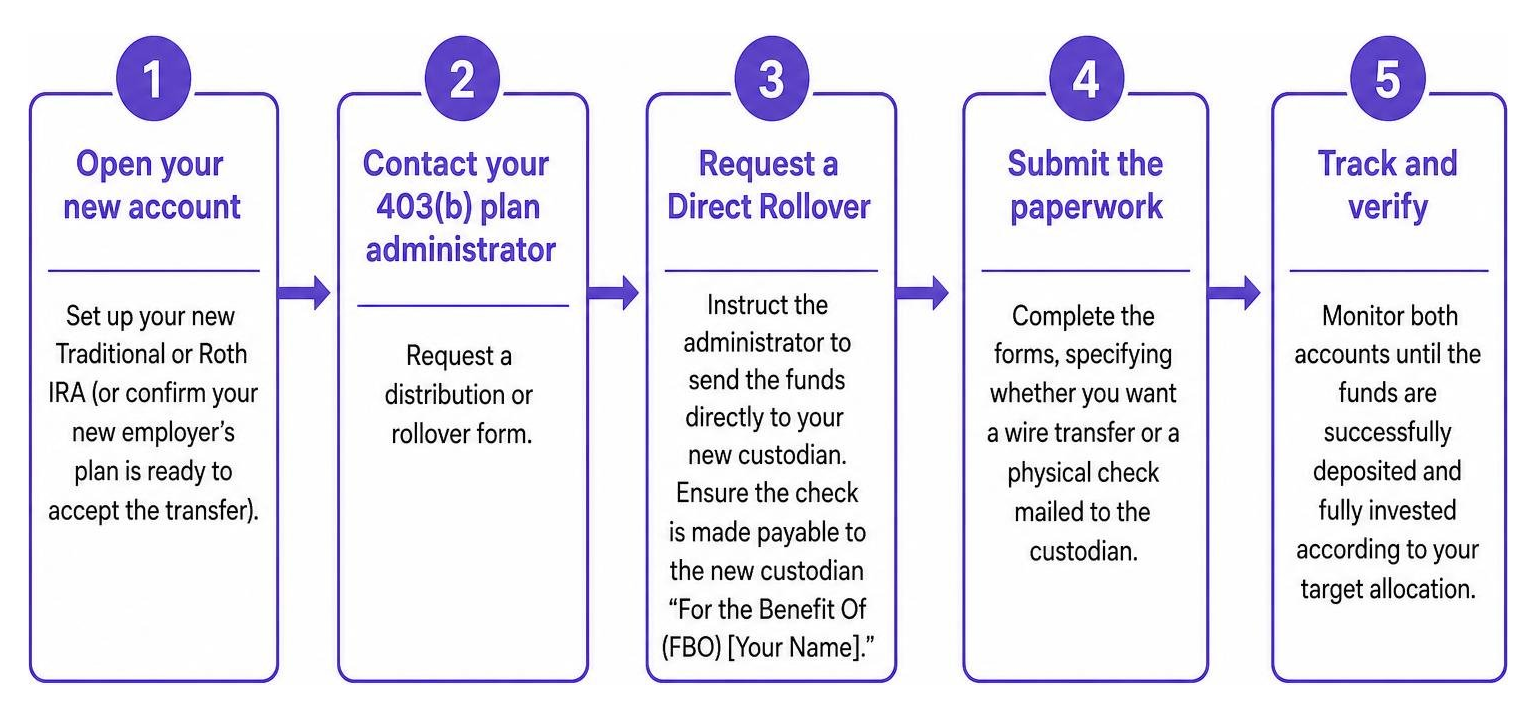
- Open your new account: Before contacting your 403(b) provider, set up your new Traditional or Roth IRA (or confirm your new employer’s plan is ready to accept the transfer).
- Contact your 403(b) plan administrator: Request a distribution or rollover form.
- Request a Direct Rollover: Instruct the administrator to send the funds directly to your new custodian. Ensure the check is made payable to the new custodian “For the Benefit Of (FBO) [Your Name].”
- Submit the paperwork: Complete the forms, specifying whether you want a wire transfer or a physical check mailed to the custodian.
- Track and verify: Monitor both accounts until the funds are successfully deposited and fully invested according to your target allocation.
Essential Paperwork and Timeline
The entire rollover process typically takes between 7 to 21 business days to complete, depending on whether the funds are sent electronically or via a physical check in the mail.
During tax season, you will receive two key documents:
- Form 1099-R: Issued by your old 403(b) provider to report the distribution to the IRS.
- Form 5498: Issued by your new custodian to report the receipt of the rollover funds, proving to the IRS that the transfer was completed tax-free.
Note for Expats: If you are a U.S. citizen or green card holder living abroad, you must file IRS Form W-8BEN to certify your foreign status and claim any applicable tax treaty benefits to avoid excessive withholding on distributions.
Frequently Asked Questions about 403b Rollovers
How do required minimum distributions (RMDs) change after a rollover?
Once you reach age 73, you must begin taking Required Minimum Distributions (RMDs) from your traditional retirement accounts. If you keep your funds in an active employer-sponsored 403(b) and are still working, you may qualify for the “still-employed exception,” allowing you to delay RMDs from that specific plan.
Once you roll those funds into a Traditional IRA, however, you must take RMDs starting at age 73, regardless of your employment status. Failure to take your RMD results in a steep 25% IRS penalty on the amount that should have been withdrawn (reduced to 10% if corrected within two years). To learn how to manage these withdrawals efficiently, read our guide on Smart Strategies to Defer Taxes and Boost Your Retirement Savings.
Can I roll over my 403b while still employed?
Generally, you cannot roll over your 403(b) funds while you are still working for the employer who sponsors the plan. However, many plans allow for an in-service distribution once you reach age 59½, or if you meet specific vesting requirements. Check your plan’s Summary Plan Description (SPD) to see if this option is available to you. For older workers looking to maximize their savings before retirement, check out The Ultimate Guide to Retirement Contribution Catch-Up Limits.
What happens to outstanding loans during a 403b rollover?
If you have an active loan on your 403(b) and leave your job, you must repay the outstanding balance within a short window (often 60 to 90 days). If you fail to repay it, the plan administrator will execute a “loan offset,” treating the unpaid balance as a taxable distribution. This means you will owe ordinary income taxes on the unpaid amount, plus a 10% early withdrawal penalty if you are under age 59½.
Conclusion
Deciding whether to roll over your 403(b) is a pivotal step in your financial journey. By understanding the 403b rollover pros—such as slashing your investment fees, consolidating your accounts, and multiplying your investment choices—you can make an active decision that aligns with your long-term retirement goals.
At ContentVibee, we are dedicated to providing clear, actionable, and step-by-step financial advice to help you navigate these complex transitions with ease.
Take control of your retirement journey today with ContentVibee and build the secure financial future you deserve.


