


Why Bracket Creep Strategies Matter More Than Ever in 2026
The best bracket creep strategies work by reducing your taxable income before inflation quietly pushes you into a higher tax bracket — costing you more without any real gain in purchasing power.
Here are the most effective ways to fight bracket creep right now:
- Maximize pre-tax retirement contributions — 401(k) up to $24,500 in 2026, traditional IRA up to $7,500
- Contribute to an HSA — up to $4,400 (individual) or $8,750 (family) in 2026, triple tax-advantaged
- Time your income strategically — defer bonuses, capital gains, or freelance payments to lower-income years
- Harvest tax losses — offset gains and up to $3,000 of ordinary income annually
- Do Roth conversions in low-income years — shrink future taxable RMDs before they force you into a higher bracket
- Bunch charitable donations — or use a donor-advised fund to exceed the standard deduction
- Review your entity structure — S-Corp election can reduce self-employment taxes for business owners
- Use asset location — place tax-inefficient investments in tax-advantaged accounts
You just got a pay raise. Congratulations — that’s genuinely good news.
But here’s the part nobody tells you at the celebration: some of that raise may quietly evaporate into a higher tax bracket, even if your real purchasing power barely moved.
That’s bracket creep. And in 2026, with wages still adjusting after years of elevated inflation, it’s affecting more households than ever.
The mechanics are straightforward. The U.S. uses a progressive tax system — as your income rises, a larger share gets taxed at higher rates. The IRS does adjust tax brackets annually for inflation (using the Chained Consumer Price Index, or C-CPI). But many other thresholds — like the 3.8% Net Investment Income Tax, which hasn’t been updated since 2013 — don’t move. So even when brackets shift slightly upward, plenty of taxpayers still find themselves paying a bigger slice of their paycheck to the IRS each year.
For mid-career professionals and those approaching retirement, the stakes are especially high. A $10,000 income bump might look great on paper. But if it nudges you past a key threshold — or reduces your eligibility for a deduction — the after-tax gain can be far smaller than expected.
The good news? This is largely a solvable problem. With the right planning moves — many of which you can start before the tax year closes — you can keep more of what you earn.
Bracket creep strategies helpful reading:
Understanding Bracket Creep and Its Impact in 2026
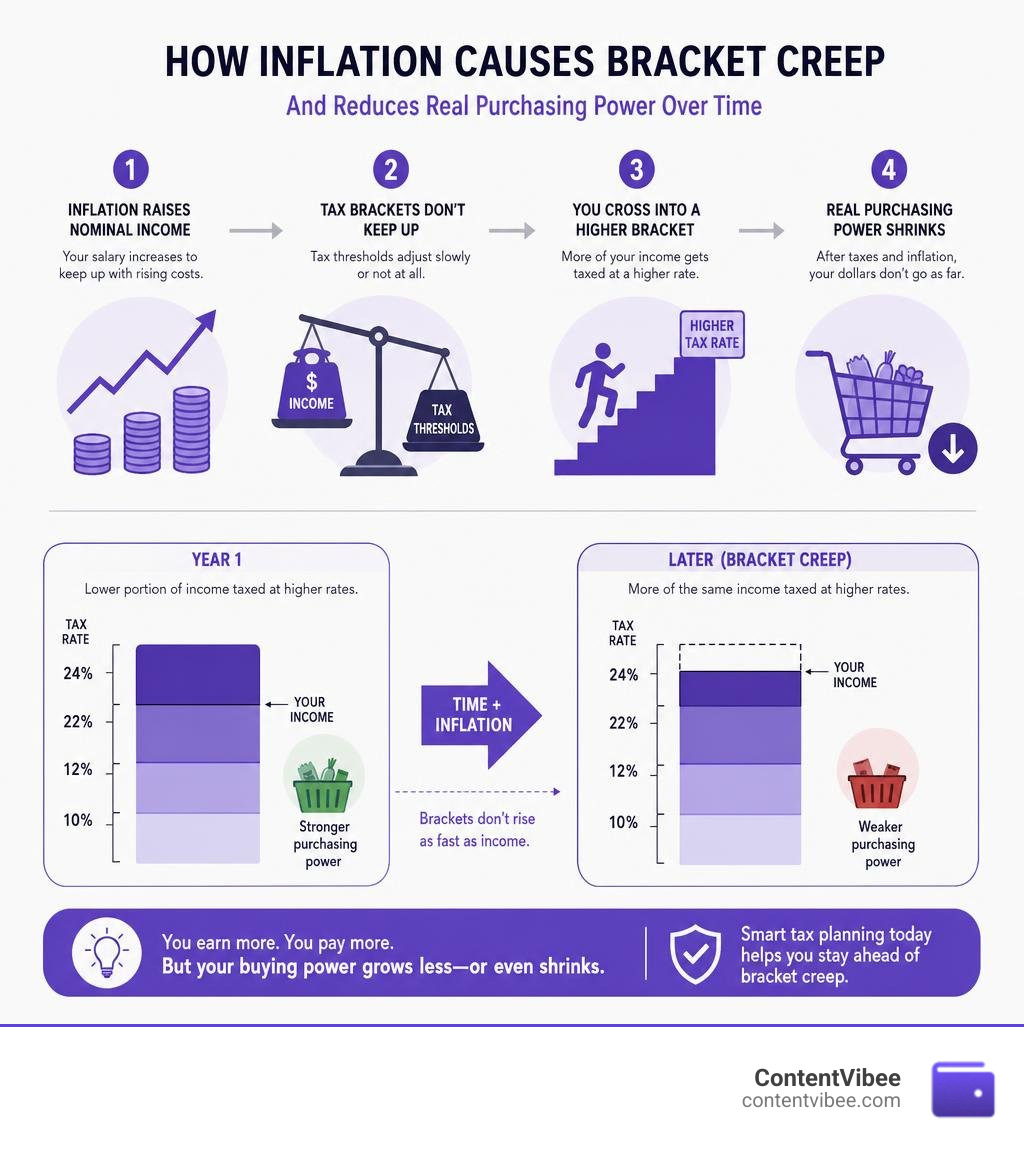
To beat bracket creep, we first have to understand how it works. At its core, bracket creep is the process where inflation pushes your nominal income (the actual number on your paycheck) into higher tax brackets, even if your real income (what that money can actually buy) hasn’t changed.
In a progressive tax system, your income is divided into segments, with each segment taxed at a progressively higher rate. We often focus on our marginal tax rate — the rate paid on the very last dollar earned. However, our effective tax rate — the total tax paid divided by our total income — is what truly determines our take-home pay.
When your wage increases strictly to keep up with the cost of living, your real purchasing power remains flat. But if that nominal raise pushes you past a tax threshold, your effective tax rate rises. Suddenly, you are paying a higher percentage of your income in taxes, leaving you with less real purchasing power than before the raise. To dive deeper into how this process plays out, read our detailed guide on The Hidden Tax Understanding Bracket Creep.
This phenomenon also creates what economists call “fiscal drag.” Because tax revenues grow faster than the broader economy during inflationary periods, bracket creep acts as an automatic drag on consumer spending.
While this is a headache for individual households, it is incredibly lucrative for governments. Globally, bracket creep is a primary driver of fiscal consolidation. For instance, in Australia, bracket creep is expected to be the most critical factor in raising the country’s tax-to-GDP ratio over the next decade. Driven by personal income tax receipts, this quiet tax hike is helping to pay down Australia’s net debt, which is expected to peak at 40.9% of GDP ($981 billion) by the end of 2024-25. Over the last forty years, periodic adjustments by the Australian government have kept their average personal income tax rate hovering between 22% and 25%, but without regular intervention, the burden on everyday workers continues to grow.
To see how these shifts directly affect your personal tax return, check out our article on Beat The Taxman How Inflation Shifts Your Tax Bracket.
How the IRS Adjusts Tax Brackets and Deductions
The IRS isn’t entirely blind to this issue. To mitigate bracket creep, the IRS adjusts more than 60 tax provisions annually for inflation. This includes the tax brackets themselves, the standard deduction, and the Earned Income Tax Credit.
However, the way the IRS calculates inflation changed under the Tax Cuts and Jobs Act (TCJA) of 2017. The IRS switched from the traditional Consumer Price Index (CPI-U) to the Chained Consumer Price Index (C-CPI).
The difference is subtle but highly impactful:
- Traditional CPI (CPI-U) assumes that if the price of beef rises, consumers keep buying the same amount of beef.
- Chained CPI (C-CPI) accounts for consumer substitution. It assumes that if beef prices spike, you will buy chicken instead.
Because C-CPI assumes consumers will swap to cheaper alternatives, it reports a lower rate of inflation than traditional CPI. Consequently, the IRS adjusts tax brackets and standard deductions upward at a slower rate. Over time, this slower indexing process drags more taxpayers into higher brackets—meaning bracket creep is still very much alive.
Let’s look at how the standard deduction and key brackets compare between 2025 and 2026:
| Tax Parameter | 2025 Tax Year | 2026 Tax Year |
|---|---|---|
| Standard Deduction (Single) | $15,750 | $14,600 |
| Standard Deduction (MFJ) | $31,500 | $29,200 |
| 10% Bracket (Single) | Up to $11,925 | Up to $11,600 |
| 12% Bracket (Single) | $11,926 – $48,475 | $11,601 – $47,150 |
| 22% Bracket (Single) | $48,476 – $103,350 | $47,151 – $100,525 |
| 24% Bracket (Single) | $103,351 – $197,300 | $100,526 – $191,650 |
(Note: The standard deductions and bracket limits for 2026 reflect adjustments under evolving tax legislation, making proactive planning essential.)
The real danger zone lies in the tax provisions that are not adjusted for inflation. These unindexed thresholds act as built-in wealth traps.
The most prominent example is the Net Investment Income Tax (NIIT). This 3.8% surtax applies to capital gains, dividends, and interest income for single filers with a Modified Adjusted Gross Income (MAGI) over $200,000, and married couples filing jointly over $250,000. These thresholds have remained completely unchanged since the tax was introduced in 2013. Thanks to inflation and nominal wage growth, a tax originally designed for ultra-high earners now routinely hits upper-middle-class families.
Similarly, we must monitor the Alternative Minimum Tax (AMT) phaseouts and phaseout ranges for credits and deductions, which can create steep “shadow” tax rates as your income rises.
Proactive Bracket Creep Strategies to Lower Your Taxable Income
Now that we have diagnosed the problem, let’s focus on the cure. Defeating bracket creep requires a year-round approach to tax planning. By strategically lowering your taxable income, you can keep your marginal rate in check and preserve your hard-earned money.

Implementing Pre-Tax Bracket Creep Strategies
The most immediate line of defense against bracket creep is utilizing pre-tax accounts. Every dollar you route into these accounts is a dollar the IRS cannot tax this year, effectively lowering your taxable income and dropping you into a lower bracket.
First, maximize your employer-sponsored retirement plans. In 2026, you can contribute up to $24,500 to a traditional 401(k) or 403(b) plan. If you are age 50 or older, you can make an additional catch-up contribution of $8,000. For those aged 60 to 63, a special catch-up limit of $11,250 applies, offering an incredible opportunity to slash taxable income. Traditional IRA contributions are capped at $7,500 (plus a $1,100 catch-up for those 50+). To master these retirement vehicles, check out our guide on Smart Strategies To Defer Taxes And Boost Your Retirement Savings.
Next, leverage a Health Savings Account (HSA) if you have an eligible high-deductible health plan (HDHP). HSAs offer a rare “triple tax advantage”:
- Contributions are 100% tax-deductible.
- The account balances grow completely tax-free.
- Withdrawals are tax-free when used for qualified medical expenses.
For 2026, the HSA contribution limits are $4,400 for individuals and $8,750 for families. If you are 55 or older, you can add an extra $1,000 catch-up contribution. By maxing out both your 401(k) and your HSA, a married couple can easily shave over $30,000 off their taxable income, successfully dodging a higher tax bracket.
Long-Term Bracket Creep Strategies for Retirement Planning
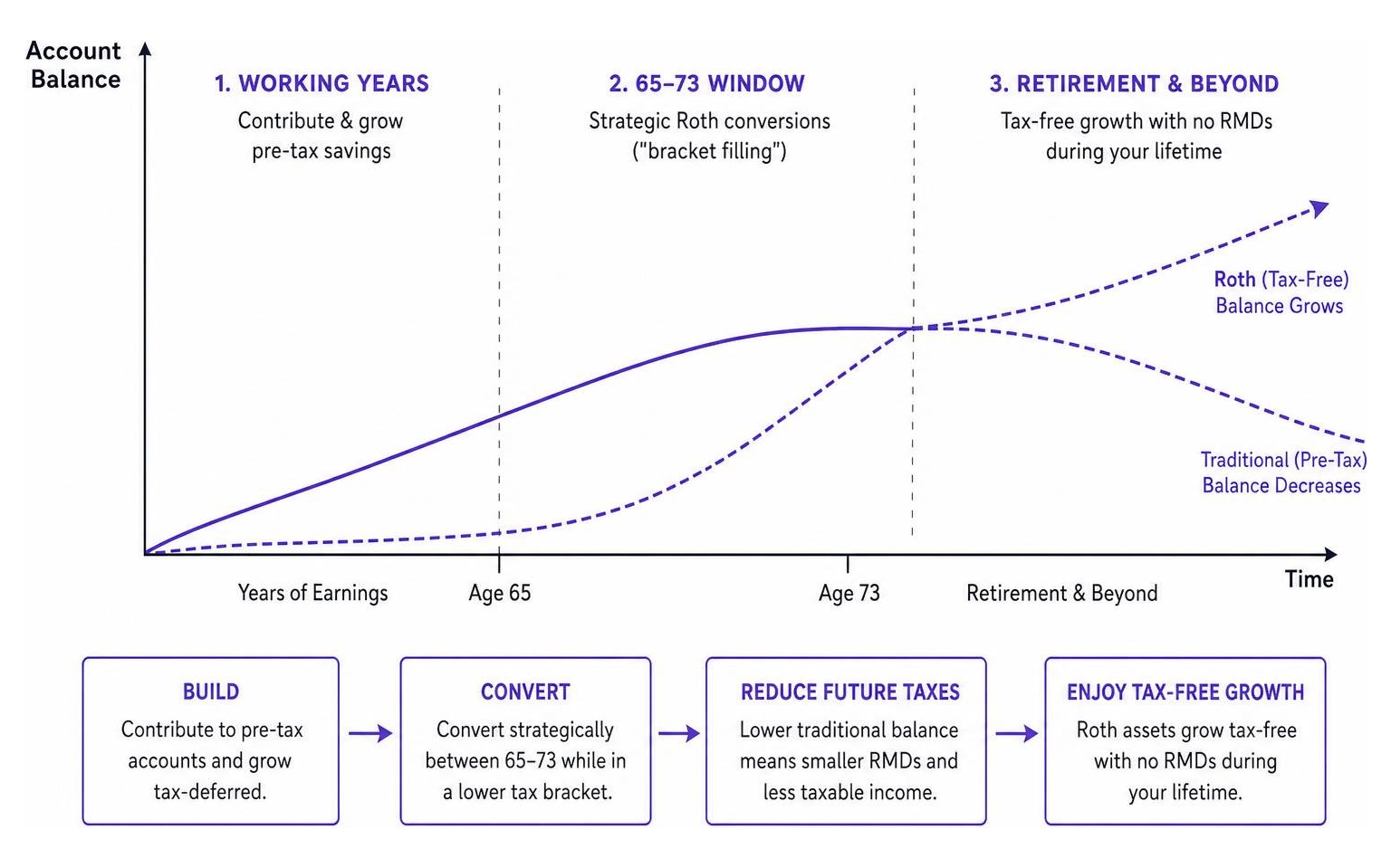
While pre-tax contributions help you today, they create a massive tax liability for the future. When you reach retirement, withdrawals from traditional retirement accounts are taxed as ordinary income. Even worse, at age 73, you must begin taking Required Minimum Distributions (RMDs). If you have a large pre-tax balance, these forced RMDs can trigger a massive “tax bomb,” pushing you into a higher tax bracket when you can least afford it.
To prevent this, affluent savers utilize the 65-to-73 window. This is the sweet spot between your retirement and the start of your RMDs (and often before you claim delayed Social Security benefits). During these low-income years, you can perform strategic, partial Roth conversions.
By converting a portion of your traditional 401(k) or IRA into a Roth IRA each year, you pay taxes on that money at your current, lower marginal rate. This process is known as “bracket filling” — you convert just enough to fill up your current low tax bracket (such as the 12% or 22% bracket) without crossing into the next tier.
This strategy offers three massive benefits:
- It shrinks your traditional IRA balance, reducing your future RMD tax burden.
- Roth IRAs do not have RMDs during your lifetime, giving you complete control over your taxable income.
- It protects you from Medicare IRMAA (Income Related Monthly Adjustment Amount) surcharges. IRMAA uses a two-year lookback on your MAGI to determine your Medicare premiums. If your RMDs push you over the $218,000 threshold (for married couples), your monthly premiums can spike dramatically.
Additionally, pay attention to asset location. Place your most tax-inefficient assets (like high-yield bonds or actively managed mutual funds that pay out regular dividends) inside tax-advantaged retirement accounts. Keep tax-efficient assets (like index funds or stocks held for long-term growth) in your taxable brokerage accounts.
Tactical Investment and Giving Strategies
Beyond retirement accounts, you can use active portfolio management and charitable giving to keep your taxable income low.
Tax-loss harvesting is the practice of selling underperforming investments at a loss to offset capital gains realized elsewhere in your portfolio. If your losses exceed your gains, you can use the remaining losses to offset up to $3,000 of ordinary income. Any excess losses can be carried forward to future tax years. Just be sure to avoid the wash-sale rule, which prevents you from claiming the tax loss if you buy a “substantially identical” security within 30 days before or after the sale.
When it comes to philanthropy, simple cash donations often don’t provide a tax benefit unless you itemize your deductions. Because the standard deduction is so high, most taxpayers are better off using a bunching strategy. Instead of giving $5,000 to charity every year, you can “bunch” three years of donations ($15,000) into a single tax year using a donor-advised fund (DAF). This allows you to claim a massive itemized deduction in the year of the contribution, while distributing the money to your favorite charities over time.
For retirees over age 70½, Qualified Charitable Distributions (QCDs) are the ultimate giving tool. You can transfer up to $111,000 per year directly from your traditional IRA to a qualified charity. This transfer is completely excluded from your adjusted gross income (AGI) and counts directly toward satisfying your annual RMD.
Managing Bracket Creep for Small Business Owners and Equity Compensation
Small business owners and professionals with equity compensation face unique bracket creep challenges. Because pass-through entities (sole proprietorships, partnerships, LLCs, and S-Corporations) report profits directly on the owner’s personal tax return, a highly successful business year can instantly catapult the owner into the highest personal tax brackets.

Fortunately, business owners have access to powerful tax management tools:
- S-Corporation Election: By electing S-Corp status, you can split your business income into a “reasonable salary” (subject to payroll taxes) and shareholder distributions (exempt from payroll taxes). This move alone can save a business owner earning $150,000 roughly $10,000 annually in self-employment taxes.
- Section 179 and Bonus Depreciation: If your business is facing an income spike that threatens to push you into a higher bracket, you can purchase qualifying business equipment and deduct up to 100% of the cost in the current tax year under Section 179 and IRS Notice 2026-16.
- Qualified Business Income (QBI) Deduction: Section 199A allows eligible business owners to deduct up to 20% of their qualified business income. However, this deduction phases out quickly once your taxable income crosses specific thresholds. Failing to manage your bracket creep can cause you to lose your QBI deduction entirely, leading to a massive increase in your effective tax rate.
If you are an employee compensated with stock options or Restricted Stock Units (RSUs), timing is everything. Selling all your shares in a single year to diversify can create a massive tax spike, triggering both the top marginal tax bracket and the 3.8% NIIT.
To manage this, spread your stock sales over multiple tax years. Alternatively, you can use installment contracts for large asset sales to receive payments (and recognize taxable income) gradually over time.
Geographic and State-Level Tax Considerations
While federal taxes get the most attention, state income taxes can quietly compound the effects of bracket creep. Not all states index their tax brackets for inflation. In states with stagnant brackets, even modest cost-of-living raises will steadily increase your state tax burden.
Your choice of residency plays a massive role in your overall tax planning. If you are planning a major taxable event — such as selling a business, exercising stock options, or executing a large Roth conversion — timing your move to a tax-friendly state can save you tens of thousands of dollars.
To see which states offer the most favorable tax environments, explore our detailed rankings:
- Read about Which States Have The Lowest Tax Burdens to optimize your current earning years.
- If you are planning your golden years, check out Best States For Taxes In Retirement Ranked to find the best place to protect your savings.
For a global perspective on how other countries manage these issues, you can read about the Australian approach to trusts and negative gearing in this guide on Strategies to Avoid Income Tax Bracket Creep – Spark Financial Group.
Frequently Asked Questions About Bracket Creep
What is bracket creep and how does it affect my purchasing power?
Bracket creep occurs when inflation drives up your nominal income, pushing you into a higher tax bracket. Because tax brackets and deductions may not rise as fast as inflation, your effective tax rate increases. Even if your raise matches inflation, you end up paying a larger percentage of your income to the government, reducing your real purchasing power.
Does the IRS adjust all tax provisions for inflation to prevent bracket creep?
No. While the IRS adjusts federal tax brackets and the standard deduction annually using the Chained Consumer Price Index (C-CPI), many critical tax thresholds remain completely unindexed. Surcharges like the 3.8% Net Investment Income Tax (NIIT) and various tax credit phaseouts have remained flat for years, creating unindexed tax traps for growing incomes.
How do retirement contributions and HSAs help me stay in a lower tax bracket?
Contributions to traditional 401(k)s, traditional IRAs, and HSAs are made with pre-tax dollars. This means they are deducted directly from your gross income, reducing your Adjusted Gross Income (AGI) dollar-for-dollar. By lowering your taxable income, these contributions can keep you below the threshold of the next marginal tax bracket.
Conclusion
Bracket creep is a quiet, persistent tax on your success. But as we have explored, it is a challenge you can actively manage. By implementing proactive bracket creep strategies — from maximizing your pre-tax contributions and timing your income to executing multi-year Roth conversions — you can take control of your financial future and keep your hard-earned money where it belongs: in your pocket.
At ContentVibee, we are committed to providing you with clear, actionable steps to build your wealth and achieve long-term financial security. For more essential advice on protecting your retirement income, continue reading our guide on Taxing Your Golden Years: A Guide to Social Security Tax on Benefits.


