


What to Look for in a 403(b) Rollover Provider
Choosing the right 403b rollover provider is one of the most important financial decisions you’ll make when leaving a nonprofit, school, or hospital job. Get it right, and you could unlock lower fees, more investment choices, and a cleaner path to retirement. Get it wrong, and you risk surprise tax bills, IRS penalties, or years of underperformance locked inside a high-cost annuity.
Here are the top factors to look for in a 403(b) rollover provider:
- No account fees or low expense ratios — look for providers offering index funds under 0.10% annually
- Broad investment selection — stocks, ETFs, and mutual funds, not just annuities
- Direct rollover support — the provider should handle trustee-to-trustee transfers to avoid the 20% IRS withholding trap
- Strong digital tools — retirement calculators, portfolio tracking, and easy online account management
- Fiduciary standard — your advisor must be legally required to act in your best interest
- Responsive customer support — especially important during a rollover, which can take 2 to 4 weeks
Most people don’t realize that 403(b) plans — which cover school teachers, hospital workers, and nonprofit employees — hold around $1.26 trillion in assets nationwide, compared to over $8.7 trillion in 401(k) plans. That size difference matters: 403(b) plans often come with fewer investment options and higher fees. Rolling over to the right provider can change that picture significantly.
The stakes are real. Many 403(b) accounts are locked inside annuity products charging 1% to 2% in annual fees. Over a 20-year retirement, that drag can cost well over $100,000 in lost growth.
This guide will walk you through exactly how to evaluate and pick the best provider for your situation — whether you’re rolling into a traditional IRA, a Roth IRA, or a new employer’s 401(k).
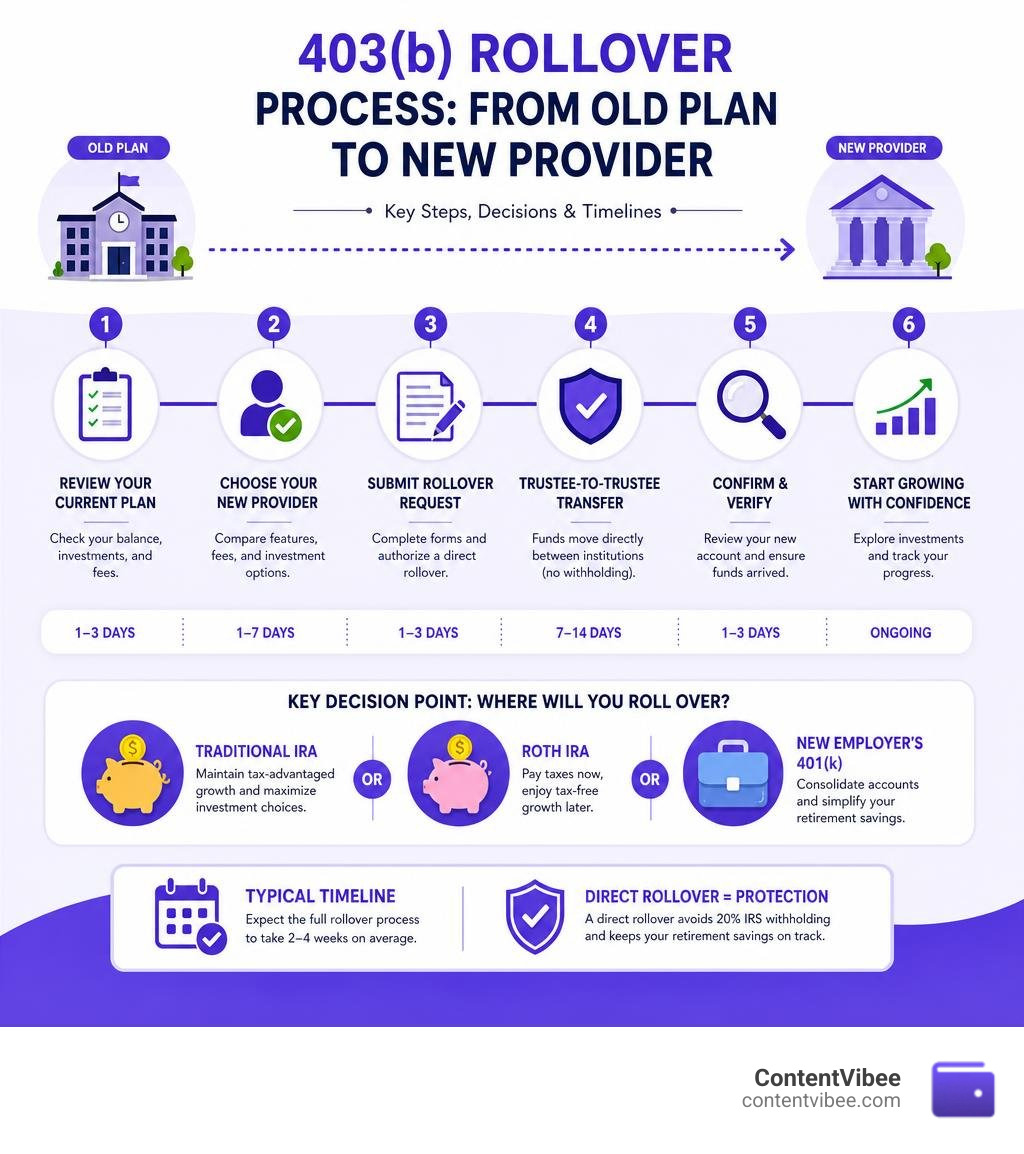
Why Roll Over Your 403(b) and What Are Your Options?
If you have recently left your job in the public school system, a hospital, or a 501(c)(3) nonprofit, you might feel like your old retirement account is just another item on a never-ending “to-do” list. It sits there, quietly minding its own business, while you navigate a new workplace culture or enjoy your retirement. But leaving your money behind can limit your growth and make your financial life needlessly complicated.
Historically, 403(b) plans have been dominated by insurance companies offering high-cost, restrictive variable annuities. By moving your funds to a dedicated 403b rollover provider, you gain access to a broader world of low-cost index funds, exchange-traded funds (ETFs), and individual stocks.
Additionally, consolidation is a major benefit. Managing multiple retirement plans from three or four past employers is like trying to keep track of a junk drawer filled with loose keys. Rolling those accounts into a single Individual Retirement Account (IRA) simplifies your life, making it much easier to manage your asset allocation and track your progress.
Understanding Your Rollover Options
When you decide to move your 403(b) money, you have several primary destinations to choose from:
- Traditional IRA: This is the most common choice. If you roll your pre-tax 403(b) funds into a Traditional IRA, the transaction is entirely tax-free. Your money will continue to grow tax-deferred until you make withdrawals in retirement. To understand the mechanics of this move, check out our guide on Breaking Up With Your Employer How To Roll A 403B Into An Ira.
- Roth IRA: You can roll your pre-tax 403(b) funds into a Roth IRA, but this is treated as a Roth conversion. You will owe ordinary income tax on the converted amount in the year of the transfer. However, once the money is in the Roth IRA, it grows tax-free, and qualified withdrawals in retirement are completely tax-free. Learn more about whether this makes sense for you in our article, Can You Move Your 403B To A Roth Ira.
- A New Employer’s 401(k) or 403(b) Plan: If your new employer allows “roll-ins,” you can move your old 403(b) balance directly into your new workplace plan. This is a great option if your new employer’s plan has exceptionally low fees and excellent investment options. It also keeps all your active workplace retirement savings under one roof. For a detailed walkthrough, read our guide on Moving On Up The Step By Step Guide To A 403B To 401K Rollover.
- Cashing Out (Not Recommended): While you can technically withdraw your funds, doing so is highly discouraged. If you cash out before age 59½, you will owe ordinary income taxes on the entire balance plus a 10% IRS early withdrawal penalty. Before taking this risky step, use our Before You Cash Out Use This 401K Withdrawal Calculator First to see how much of your hard-earned money you’ll lose to taxes and penalties.
To help you visualize your choices, we’ve summarized how these options stack up:
| Destination | Tax Implications | Investment Flexibility | Key Advantage |
|---|---|---|---|
| Traditional IRA | Tax-deferred (no immediate tax) | Excellent (Stocks, ETFs, Mutual Funds) | Total control, account consolidation |
| Roth IRA | Taxable conversion (income tax due now) | Excellent (Stocks, ETFs, Mutual Funds) | Tax-free growth and tax-free withdrawals |
| New 401(k) / 403(b) | Tax-deferred (no immediate tax) | Moderate (Limited to plan lineup) | Keeps active savings together; Rule of 55 eligible |
| Cash Out | Fully taxable + 10% early withdrawal penalty | None | Immediate cash (but high financial loss) |
Key Rules and Contribution Limits for 2026
When planning your retirement strategy, keeping up with the current IRS guidelines is essential. For the 2026 tax year, the annual contribution limit for 403(b) plans is $24,500. If you are age 50 or older, you can take advantage of catch-up contributions to save an additional $8,000, bringing your total allowable employee contribution to $32,500.
Furthermore, the maximum combined employee and employer contribution limit for 403(b) plans has risen to $72,000 in 2026. For a deeper dive into how these limits are structured, explore The New 2026 Maximum 401K Contribution Limits Explained and The Ultimate Guide To Retirement Contribution Catch Up Limits.
To put these figures into perspective, the average SoFi personal loan funded recently was around $33,000. This is remarkably close to the average retirement account balance that many mid-career professionals manage when they transition jobs. Leaving a balance of this size in a high-fee, poorly managed account can quietly drain your future wealth.
Before making your move, refer to the official IRS Rollover Chart to verify that your old and new accounts are legally compatible.
Direct vs. Indirect Rollovers: Avoiding IRS Penalties
Once you have chosen your destination, you must decide how to move the money. There are two primary methods: a direct rollover and an indirect rollover. We strongly recommend using a direct rollover whenever possible.
The Direct Rollover (The Safe Path)
In a direct rollover (also known as a trustee-to-trustee transfer), your current 403(b) plan administrator sends your funds directly to your new 403b rollover provider. The money never touches your personal bank account.
Because you never take personal possession of the money, the IRS does not view this as a distribution. There is no tax withholding, no risk of missing deadlines, and zero penalties. It is clean, efficient, and highly secure.
The Indirect Rollover (The Risky Path)
An indirect rollover occurs when your 403(b) provider cuts a check made out directly to you. You deposit the money into your personal bank account with the intention of moving it to your new retirement account.
However, the IRS imposes strict rules on this process:
- The 60-Day Rule: You have exactly 60 days from the date you receive the distribution to deposit the entire amount into your new IRA or employer plan. If you miss this window by even a single day, the IRS treats the entire distribution as taxable income, and you may owe a 10% early withdrawal penalty if you are under age 59½. For a guide on how to navigate this timeline, check out How Long Do You Have To Rollover A 401K After Quitting.
- The 20% Withholding Tax: By law, your old plan administrator must withhold 20% of your account balance for federal income taxes when sending an indirect distribution. For example, if you have a $30,000 balance, you will only receive a check for $24,000.
- The Replacement Trap: To complete a tax-free rollover, you must deposit the full gross amount ($30,000) into your new account within 60 days. This means you must come up with the missing 20% ($6,000) out of your own pocket to complete the deposit. You will eventually get that withheld 20% back as a tax credit when you file your tax return the following year, but finding thousands of dollars on short notice can be a major financial strain.
If you find yourself forced into an indirect transfer, read our detailed guide on How To Complete An Indirect Rollover Without Irs Penalties to avoid costly mistakes.
How to Choose the Best 403b Rollover Provider Online
Choosing a 403b rollover provider requires looking beyond flashy marketing and focusing on the underlying fee structures, investment choices, and customer support.
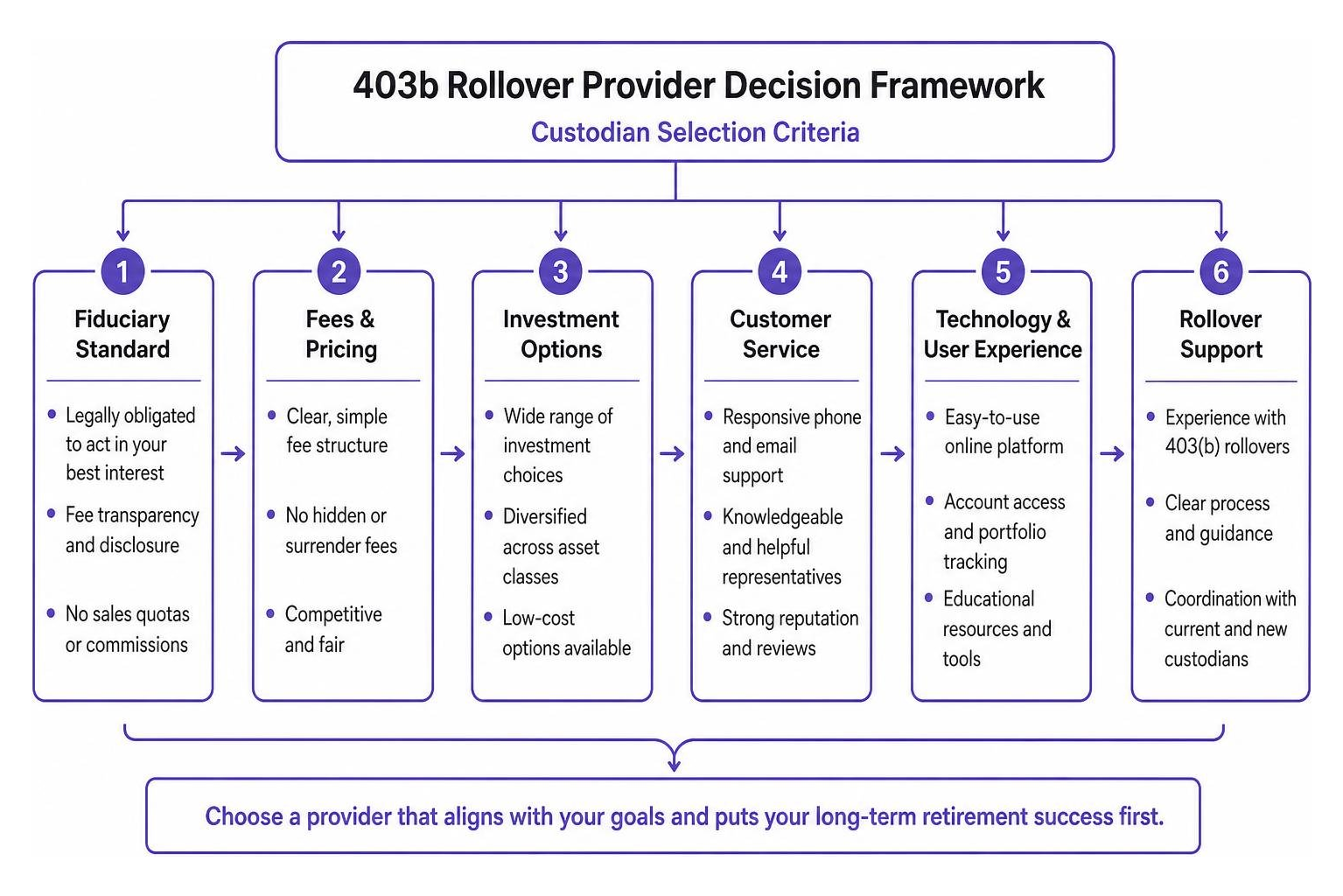
When comparing online platforms, ask yourself the following questions:
- Are they a fiduciary? Ensure the provider or advisor operates under the fiduciary standard, meaning they are legally obligated to recommend investments that are in your best interest rather than products that pay them high commissions.
- What is their customer service reputation? Moving retirement assets involves coordination between different financial institutions. You want a provider that offers responsive phone support and clear guidance throughout the transfer process.
- Are their digital tools user-friendly? A great provider should offer intuitive online portals, robust portfolio tracking, and educational resources to help you manage your money easily.
Comparing Fee Structures of a 403b Rollover Provider
Fees are the silent killers of long-term investment growth. When evaluating a potential custodian, look closely at their fee schedule:
- Administrative Fees: Many top-tier online brokerages charge $0 in annual account maintenance fees. Avoid any provider that charges ongoing flat fees just to keep your account open.
- Expense Ratios: This is the annual fee charged by the mutual funds or ETFs themselves. Look for a provider that gives you access to low-cost index funds with expense ratios below 0.10%.
- Annuity Surrender Charges: If your current 403(b) is housed within an annuity, be prepared for potential surrender charges. These fees can range from 5% to 10% of your total account value if you exit the contract early. A quality rollover provider can help you evaluate these exit costs and determine if waiting or moving immediately is more financially advantageous.
Investment Selection and Tools Offered by a 403b Rollover Provider
A major benefit of leaving an employer-sponsored 403(b) is gaining freedom of choice. While your old workplace plan might have limited you to a handful of expensive, pre-selected mutual funds, a high-quality online provider will open the door to:
- A Vast ETF and Stock Marketplace: You can build a highly customized, diversified portfolio using low-cost ETFs and individual stocks.
- Robo-Advisory Services: If you prefer a hands-off approach, many modern providers offer automated portfolio management. These digital advisors build and rebalance a portfolio for you based on your personal risk tolerance and retirement timeline.
- Planning Calculators: Look for interactive tools that allow you to model different retirement scenarios, project your future balances, and calculate required minimum distributions (RMDs).
Step-by-Step Rollover Process and Expat Rules
Once you have selected your new provider, the actual transfer process generally takes between 2 to 4 weeks. If you are ready to begin, we recommend reading our Step By Step Guide To Moving Your 403B To Vanguard to see an example of how this works in practice.
Here is the general sequence of events:
- Open the Receiving Account: You must open your new Traditional or Roth IRA before you initiate the transfer. Having your new account number ready ensures the funds have a clear destination.
- Request a Distribution Form: Contact your old 403(b) plan administrator and request a “rollover distribution form.”
- Specify a Direct Rollover: Fill out the paperwork indicating that you want a direct, trustee-to-trustee transfer. The check should be made payable to your new custodian “For the Benefit Of (FBO) [Your Name].”
- Submit and Track: Send the completed paperwork to your old plan administrator. Keep a log of your submission dates and follow up if the funds do not arrive at your new custodian within three weeks.
Special Rules for Expats and Non-Resident Aliens
If you are a U.S. expat or a non-resident alien who previously worked in the United States, managing a 403(b) rollover comes with unique cross-border tax challenges:
- Withholding Taxes: Non-resident aliens face a mandatory 30% withholding tax on U.S. retirement distributions. However, you may be able to reduce this rate if your country of residence has a double taxation treaty with the United States. You must file Form W-8BEN to certify your foreign status and claim these treaty benefits.
- Residency Restrictions: Many major U.S. brokerage firms have strict policies regarding foreign addresses. If you move abroad, some custodians may freeze your account or restrict your ability to buy new mutual funds. It is vital to choose a rollover provider that specializes in working with international clients and expats.
Frequently Asked Questions about 403(b) Rollovers
Can I roll over my 403(b) while still employed?
Yes, but only under specific circumstances. This is known as an “in-service distribution.” Most employer-sponsored plans only allow in-service distributions once you reach age 59½. Additionally, your plan must specifically write this option into its rules. Contact your current HR department or plan administrator to find out if your plan allows in-service rollovers.
What happens if I over-contribute during a rollover year?
A rollover does not count toward your annual contribution limits. For example, if you roll over $50,000 from an old 403(b) to a Traditional IRA, you can still contribute up to the maximum allowable limit to your IRA for that tax year. However, if you accidentally make normal contributions that exceed the IRS limits, you must correct the mistake quickly to avoid a 6% annual excise tax on the excess amount. For step-by-step instructions on fixing this, read How To Correct Over Contributing To Your Ira Before The IRS Finds Out.
How long does a 403(b) rollover typically take?
A standard direct rollover usually takes between 7 to 21 business days (about 2 to 4 weeks). The timeline can be delayed if your old account is tied up in annuity contracts, which require additional liquidation steps, or if the old provider insists on mailing a physical paper check rather than executing an electronic wire transfer.
Conclusion
Rolling over your old 403(b) is a powerful way to reclaim control of your financial future. By moving your hard-earned savings away from restrictive employer plans and high-cost annuities, you can drastically reduce your annual fees, expand your investment options, and simplify your retirement planning.
When choosing an online 403b rollover provider, prioritize institutions that act as fiduciaries, offer low-cost index funds, provide robust digital tools, and assist you with a safe, direct trustee-to-trustee transfer.
At ContentVibee, we believe that retirement planning shouldn’t feel like navigating a maze. Taking charge of your accounts today ensures that your money works just as hard for your future as you did to earn it. Take a look at your old accounts, choose a high-quality custodian, and start building a cleaner, more profitable path to retirement.


