


Why Your Retirement Cost of Living Determines How Far Your Travel Dreams Can Go
Retirement cost of living is one of the most important numbers you’ll ever calculate — and most people get it wrong.
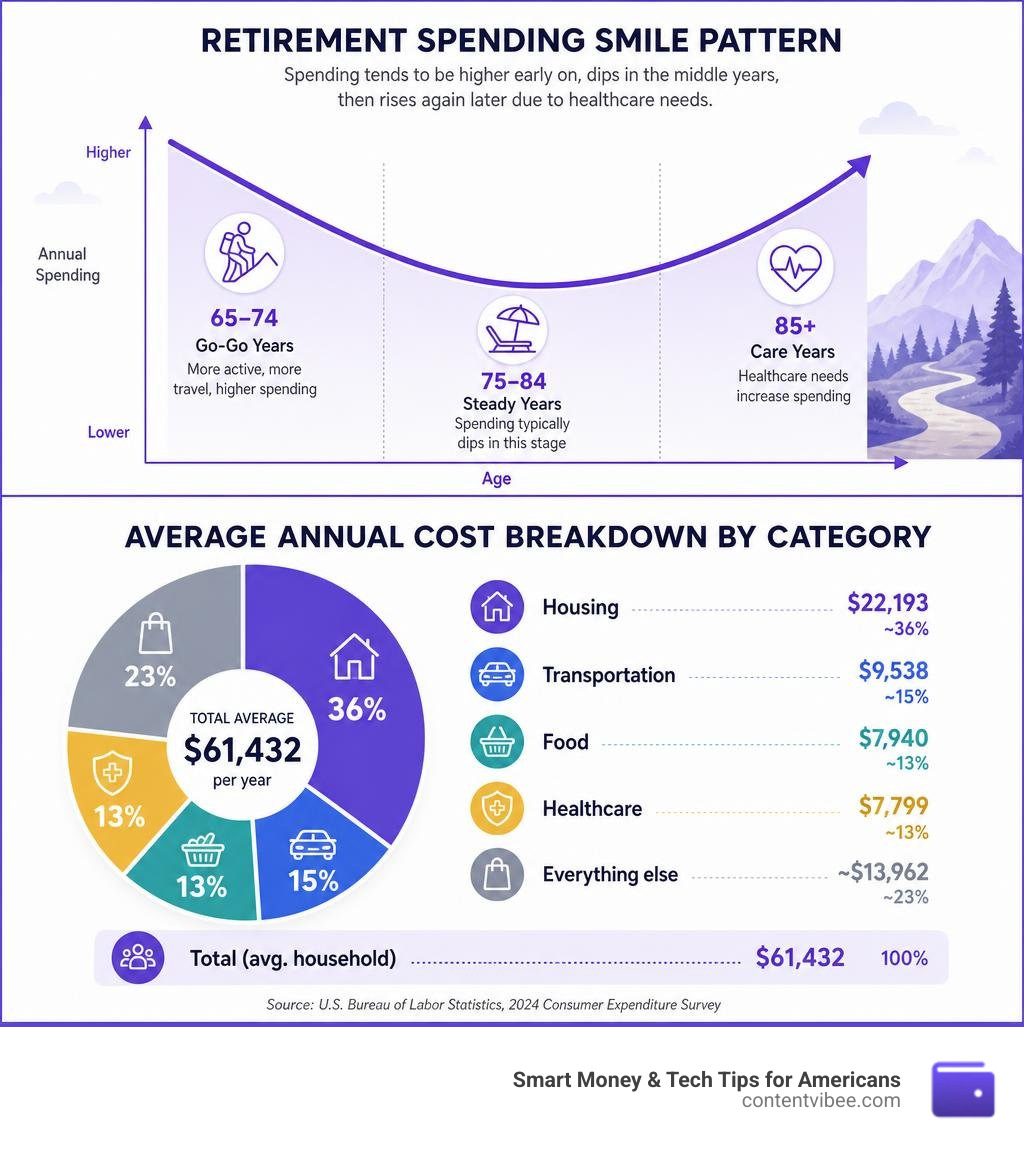
Here’s a quick snapshot of what retirees actually spend, so you can see where you stand:
| Expense Category | Average Annual Cost | % of Budget |
|---|---|---|
| Housing | $22,193 | ~36% |
| Transportation | $9,538 | ~15% |
| Food | $7,940 | ~13% |
| Healthcare | $7,799 | ~13% |
| Everything else | ~$13,962 | ~23% |
| Total (avg. household) | $61,432 | 100% |
Source: U.S. Bureau of Labor Statistics, 2024 Consumer Expenditure Survey
The average retiree household spends $61,432 per year — about $5,119 per month. But that number is just a starting point. Your actual costs depend heavily on where you live, how active you want to be, and how healthy you stay.
Here’s what makes this especially important for people planning to travel in retirement: discretionary spending — including travel — competes directly with your fixed costs. If housing and healthcare eat up 50% of your budget before you book a single flight, your travel dreams shrink fast.
The good news? Retirement spending isn’t a straight line. Research shows it follows what experts call a “spending smile” — you spend the most in your early retirement years (ages 65–74, the go-go years), less in your mid-70s and early 80s, then spending climbs again after 85 as healthcare costs rise. That early window is exactly when most people want to travel — which means planning ahead matters more than ever.
And the gap between people who plan well and those who don’t is enormous. A single retiree needs anywhere from $644,000 (in a low-cost state like North Dakota) to over $1 million (in New Jersey, Hawaii, or California) just to cover basic comfortable living — before factoring in travel.
Retirement cost of living vocabulary:
Balancing Your Retirement Cost of Living with Travel Dreams
When we transition into retirement, many of us envision checking off destinations we’ve spent decades dreaming about. However, reality requires us to balance these travel plans against our daily expenses. In 2024, the average U.S. retiree household spent $61,432 annually (a 2.2% increase from the previous year). As we look at the landscape in July 2026, inflation and shifting economic factors mean these baseline costs are only creeping upward.
To make travel work, we have to understand the “spending smile” of retirement. During the first decade of retirement—frequently called the “go-go years”—our physical health is generally at its peak, and our desire to explore is strongest. Consequently, discretionary spending on flights, cruises, and experiences spikes.
As we transition into the “slow-go years” (typically ages 75 to 84), travel naturally slows down, and overall spending dips. Finally, during the “no-go years” (ages 85 and older), spending climbs again, driven almost entirely by healthcare and long-term care needs.
To ensure your go-go years are fully funded, you must establish a clear discretionary budget. This means separating your essential survival costs (like taxes, groceries, and insurance) from your fun money. If you can accurately estimate your baseline retirement spending benchmarks, you can protect your travel funds from being slowly eaten away by unexpected daily costs.
How Your Retirement Cost of Living Changes with an Active Lifestyle
If you plan to live an active retirement filled with regular travel, your personal retirement cost of living will look vastly different from someone who prefers a quiet lifestyle close to home.
An active retirement lifestyle can easily ratchet up your required annual retirement budget by 15 percentage points compared to a low-activity lifestyle. For example, while a quiet retiree might comfortably replace 60% to 70% of their pre-retirement income, an active traveler might need to replace 80% or even 85% to maintain their desired lifestyle without stress.
Lifestyle inflation is a real risk. It’s easy to look at your retirement nest egg and feel wealthy, only to realize that booking multiple international trips a year drains your accounts faster than anticipated. To prevent this, we always recommend building a dedicated “travel budget buffer.” This is a separate bucket of cash or highly liquid assets designed specifically to fund your adventures, ensuring that a sudden spike in airfare or hotel rates won’t impact your ability to pay your monthly utility bills.
How the ‘Big Three’ Expenses Impact Your Travel Budget
To free up money for travel, we must look at the largest obstacles in our budget. In any retirement plan, housing, healthcare, and transportation make up the “Big Three” expenses. Together, they typically consume over 60% of a retiree’s total annual spending.
Let’s break down how these expenses stack up on average:
- Housing: The average retiree household spends $22,193 per year on housing, which breaks down to about $1,849 per month. This includes rent or mortgage payments, property taxes, insurance, and maintenance.
- Transportation: Staying mobile costs retirees an average of $9,538 per year ($794 per month), factoring in vehicle payments, gas, insurance, and maintenance.
- Food: Food costs average $7,940 per year ($661 per month), which includes both groceries and dining out.
If we want to maximize our travel experiences, we have to find ways to reduce these fixed costs. Every dollar we shave off our monthly housing or transportation bills is a dollar we can redirect toward a flight to Italy or a national parks road trip.
Managing Housing and Healthcare Costs to Free Up Travel Funds
The single most effective lever to lower your retirement cost of living and unlock travel funds is managing your housing. If you still have a mortgage, prioritizing a mortgage payoff before you retire can instantly reduce your monthly expenses by 25% to 30%. Alternatively, downsizing to a smaller, more energy-efficient home—or relocating to an area with lower property taxes—can free up tens of thousands of dollars in home equity that can be redirected into your travel portfolio.
Healthcare is the other major variable that can disrupt your travel plans. Many retirees mistakenly believe that Medicare covers all medical needs. In reality, Medicare has significant gaps, including deductibles, copays, and services like dental, vision, and long-term care.
According to Fidelity, a 65-year-old retired couple in 2025 needed an estimated $330,000 in assets set aside (after tax) just to cover expected out-of-pocket healthcare expenses throughout their retirement. On an individual level, retirees spend an average of $7,799 annually on healthcare, excluding long-term care.
To keep these costs from draining your travel budget, we advise:
- Shopping for Medigap or Medicare Advantage plans to cap your out-of-pocket exposure.
- Utilizing Health Savings Accounts (HSAs) if you are still working, allowing you to save tax-free dollars for retirement medical costs.
- Planning for long-term care early, whether through hybrid life/long-term care insurance or a dedicated savings buffer, so an unexpected health event doesn’t deplete your travel accounts.
Smart Strategies for Budget-Friendly Retirement Travel
Traveling in retirement doesn’t have to mean spending a fortune. In fact, retirees have a massive advantage over younger travelers: complete schedule flexibility.

By using smart, strategic travel methods, we can stretch our travel dollars further than ever:
- Off-Season Travel: Because we don’t have to worry about school calendars or limited corporate PTO, we can travel during the “shoulder seasons” (like Europe in April or October). Flights and hotels are often 30% to 50% cheaper, and the crowds are far more manageable.
- Slow Travel: Instead of rushing through five countries in ten days, consider staying in one location for a month. Renting a local apartment for a longer duration often comes with deep weekly or monthly discounts, and it allows you to live like a local, cooking your own meals and avoiding expensive tourist-trap restaurants.
- House Sitting and Home Exchanges: Websites like TrustedHousesitters allow retirees to stay in beautiful homes worldwide for free in exchange for watching a pet. This eliminates housing costs entirely, which is typically the largest travel expense.
- Travel Rewards and Credit Card Points: By strategically using credit cards for everyday purchases (like groceries and gas) and paying them off in full each month, you can accumulate points that cover flights and hotel stays.
Mapping Your Retirement Cost of Living Across Different States
One of the most powerful tools in a retiree’s financial toolkit is geographic arbitrage—moving from a high-cost, high-tax area to a region where your dollars stretch much further. The minimum savings required to support a comfortable retirement varies wildly depending on your zip code.
For instance, a single retiree needs about $898,000 in savings on average to live comfortably across the U.S. But look at how those numbers shift when we compare different states:
| State | Average Annual Retirement Cost | Estimated Nest Egg Needed (4% Rule) | Cost of Living Index |
|---|---|---|---|
| Hawaii | $129,296 | ~$1.6 Million | 184.0 |
| California | ~$101,000 | ~$1.01 Million | 138.0 |
| Florida | ~$68,000 | ~$750,000 | 103.4 |
| South Dakota | ~$61,000 | ~$680,000 | 88.6 |
| West Virginia | $58,190 | ~$658,000 | 85.0 |
Data sources compiled from Mapped: Annual Retirement Costs by State and The Minimum Savings You Need To Retire in All 50 States .
As the data shows, retiring in West Virginia or Oklahoma requires less than half the annual budget of retiring in Hawaii. If you are open to relocating, moving to a state with no state income tax (like Florida, South Dakota, or Nevada) can dramatically reduce your tax drag.
However, always research the full tax picture before packing your bags. Some states with no income tax make up for it with high property or sales taxes. To learn more about how geographic location impacts your overall financial plan, check out our Retirement Cost of Living Guide: Insights & Considerations .
Funding Travel with Part-Time Work and Social Security Optimization
If your retirement nest egg is feeling a little light for the amount of travel you want to do, you have two excellent levers to pull: phased retirement and Social Security optimization.
First, consider working a fun, low-stress part-time job specifically to fund your travel adventures. This keeps you active, provides social connection, and ensures your core retirement savings remain untouched. For ideas on flexible, senior-friendly roles, read our guide on The Best Retirement Jobs for Seniors to Stay Active and Earn.
Second, optimizing when you claim Social Security can add hundreds of thousands of dollars to your lifetime benefits. Claiming early at age 62 permanently reduces your monthly benefit by up to 30%. On the other hand, waiting past your Full Retirement Age (FRA) increases your benefit by 8% per year up to age 70.
For married couples, coordinating spousal benefits can maximize the higher earner’s benefit while protecting the surviving spouse. To build a customized strategy that maximizes your monthly cash flow, explore The Ultimate Guide to Social Security Benefit Optimization and utilize our Social Security Calculator Estimate Your Benefit Amount.
Creating a Personalized Retirement Budget and Nest Egg
To make your travel dreams a reality, you need a customized financial roadmap. Relying on generic rules of thumb can lead to costly mistakes.
Many financial planners suggest the “80% replacement ratio”—the idea that you will need 80% of your pre-retirement income to maintain your lifestyle. While this is a decent starting benchmark, your actual needs could range from 55% to over 100%, depending on your lifestyle choices, health status, and whether your home is paid off.
For example, a couple earning $100,000 pre-retirement who enters retirement with a paid-off mortgage and moderate travel plans might only need a 54% replacement ratio ($54,000/year). Meanwhile, a couple with the same income who still has ten years left on a heavy mortgage and plans to take multiple international cruises a year might need a 92% replacement ratio ($92,000/year).
Furthermore, we must account for the compounding impact of inflation. Even a mild 3% annual inflation rate will cause your cost of living to double over a 24-year retirement. A budget of $60,000 at age 65 will require roughly $145,000 by age 95 just to maintain the exact same purchasing power.
To help you get started on your own numbers, we highly recommend utilizing our Retirement Calculator Estimate Savings Needed to run personalized projections.
Calculating Your Nest Egg and Withdrawal Strategies
Once you have estimated your annual retirement cost of living, you need to determine how large of a nest egg is required to support it.
Historically, the baseline for safe withdrawals has been the “4% rule.” This rule suggests that if you withdraw 4% of your portfolio in your first year of retirement and adjust that dollar amount for inflation each subsequent year, your money has a very high probability of lasting at least 30 years.
To illustrate how this works, let’s look at the math:
$$\text{Annual Spending Gap} \times 25 = \text{Required Nest Egg}$$
If your annual spending goal is $60,000, and Social Security covers $24,000 of that, your portfolio needs to generate the remaining $36,000. Under the 4% rule, you would need a nest egg of $900,000 ($36,000 x 25).
However, the average 401(k) balance for Americans aged 55 to 64 sits at $271,000, while the median balance is nearly $96,000. This gap highlights why understanding your withdrawal rate is so critical. If you are retiring early or want to be highly conservative, aiming for a 3.5% withdrawal rate may be safer, while a stronger market environment might allow for a slightly higher rate. For a deep dive into how to apply this to your portfolio, read our guide on Demystifying the 4 Percent Retirement Withdrawal Calculator.
Tax efficiency is another crucial component. How you sequence your withdrawals matters. From taxable brokerage accounts first while allowing your traditional IRAs and Roth accounts to grow tax-deferred is often the most efficient path.
Additionally, doing partial Roth conversions in low-income years before your Required Minimum Distributions (RMDs) kick in can save you tens of thousands of dollars in lifetime taxes—leaving you with far more money to spend on your travel adventures. If you are looking for other creative ways to build your nest egg, consider exploring these Alternative Ways to Save for Retirement That Actually Work.
Frequently Asked Questions about Travel and Retirement Costs
What is the average annual retirement cost of living for a retiree?
According to the U.S. Bureau of Labor Statistics, the average retiree household (led by someone 65 or older) spent $61,432 annually in 2024. However, this figure varies dramatically by region.
Retiring in high-cost metro areas like San Francisco can require upwards of $165,000 per year, whereas comfortable living in places like Roswell, New Mexico, can cost around $45,000 annually. Healthcare is also a major variable, with average out-of-pocket costs running around $7,799 per year, not including long-term care.
How much of my pre-retirement income do I need to replace to afford travel?
While the standard “80% rule” is a common benchmark, active travelers should aim to replace 80% to 85% of their pre-retirement income during their “go-go years.”
This ensures you have a robust discretionary spending buffer specifically allocated for flights, accommodations, and tours without putting your essential living expenses at risk. As you age into your mid-70s and 80s, your travel spending will naturally decline, allowing your overall replacement ratio to drop. To get a better sense of how your personal spending might shift, read Fidelity’s expert perspective on How much will you spend in retirement? .
What are the biggest mistakes retirees make when estimating their retirement cost of living?
The most common mistakes include:
- Underestimating healthcare inflation: Healthcare costs historically rise much faster than general inflation.
- Ignoring the “tax drag”: Traditional 401(k) and IRA withdrawals are taxed as ordinary income, meaning you must withdraw more than you actually plan to spend to cover your tax bill.
- Failing to budget for home and auto maintenance: These are irregular but inevitable expenses that can easily derail a monthly budget.
- Assuming spending is flat: Forgetting that retirement spending follows a “smile” pattern can lead to underspending in early years or running out of cash in later years.
Conclusion
At ContentVibee, we believe that retirement should be a time of exploration, joy, and fulfillment—not financial stress. By understanding your true retirement cost of living, managing your fixed “Big Three” expenses, and optimizing your income sources, you can build a secure financial foundation that fully supports your travel dreams.
With careful planning, geographic arbitrage, and smart travel strategies, you can explore the world with complete peace of mind. For more actionable advice on managing your income and optimizing your benefits, Learn more about working in retirement and spousal benefits.