


Why Working After Retirement Rules Can Make or Break Your Benefits
Working after retirement rules vary widely depending on your pension system, your age, and where you work — and getting them wrong can cost you thousands of dollars in suspended or reduced benefits.
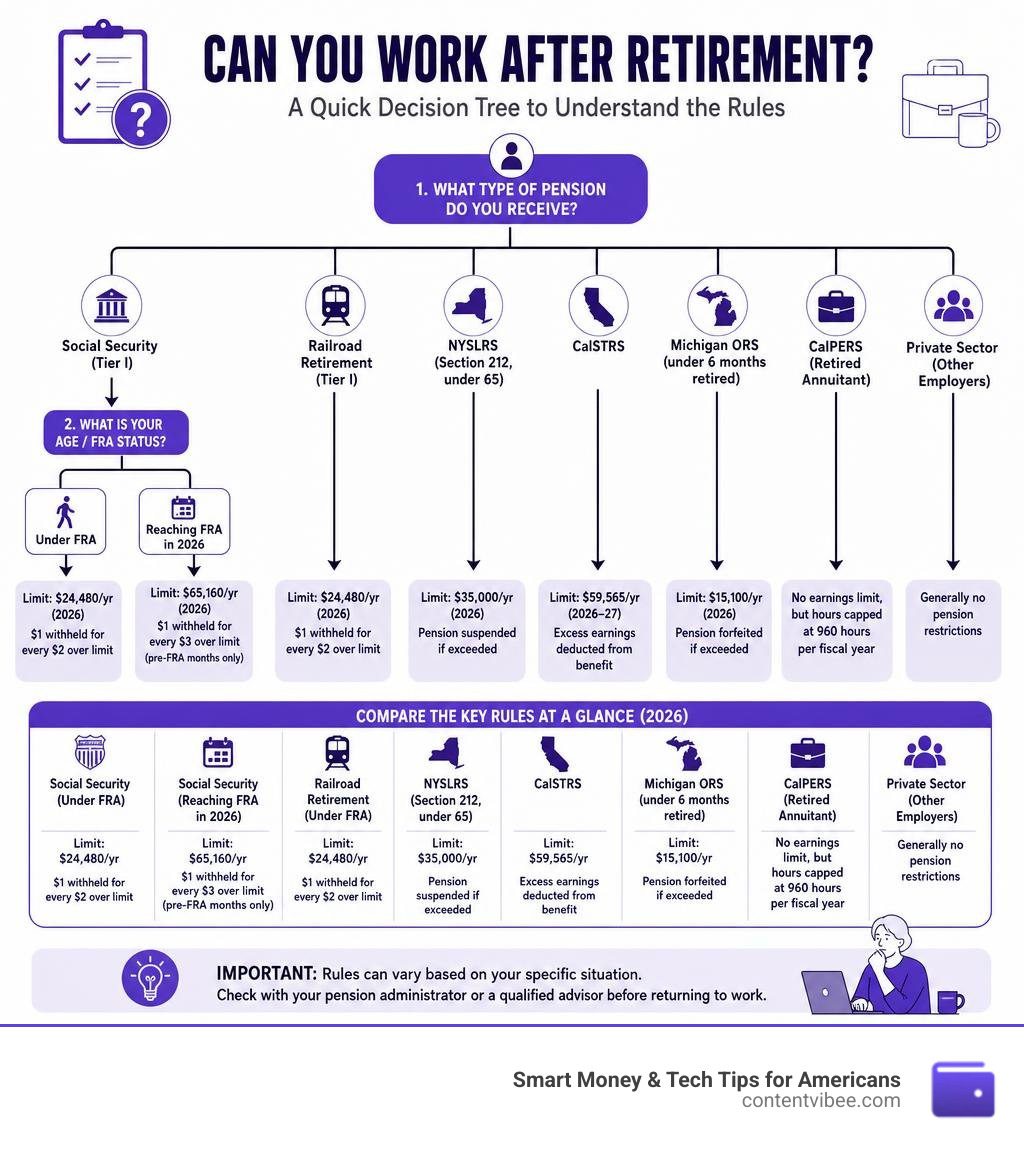
Here’s a quick overview of the key rules most retirees need to know:
| System | Key Rule | Earnings Limit (2026) |
|---|---|---|
| Social Security (under FRA) | $1 withheld per $2 over limit | $24,480/year |
| Social Security (reaching FRA in 2026) | $1 withheld per $3 over limit (pre-FRA months only) | $65,160/year |
| Railroad Retirement (under FRA) | Same as Social Security tier I | $24,480/year |
| NYSLRS (Section 212, under 65) | Pension suspended if exceeded | $35,000/year |
| CalSTRS | Excess earnings deducted from benefit | $59,565/year (2026-27) |
| Michigan ORS (under 6 months retired) | Pension forfeited if exceeded | $15,100/year |
| CalPERS (retired annuitant) | No earnings limit, but hours capped | 960 hours/fiscal year |
| Private sector | Generally no pension restrictions | None |
The financial pressure to keep working is real. According to the National Council on Aging, 80% of American households with aged adults could not make their financial ends meet in 2024. It’s no surprise that more retirees are “unretiring” — heading back to work to cover essential expenses or stay engaged.
But returning to work without understanding the rules first can trigger benefit suspensions, repayment demands, or pension recalculations that wipe out the extra income you were counting on.
This guide breaks down exactly what you need to know — whether you’re drawing Social Security, a state pension, or railroad retirement benefits — before you accept that job offer.
Relevant articles related to working after retirement rules:
- can you collect a pension and still work full-time
- retirement bridge jobs examples
- seniors working past retirement
Understanding the Core Working After Retirement Rules
When we talk about returning to work after retirement, the rules generally divide into two worlds: the private sector and the public sector. If you are drawing a pension from a public system (like a state government, school district, or public university) and you take a job in the private sector, you are usually in the clear. Private sector employers are not “covered employers” under your public retirement system, meaning you can earn as much as you like without risking your public pension.
However, if you return to work for a “covered employer” within the same retirement system that pays your pension, you run headfirst into “double-dipping” laws. These regulations exist to prevent public employees from retiring on Friday, drawing a pension on Monday, and returning to their same or a similar public job to draw a full salary at the same time.
If you violate these double-dipping laws, the consequences are swift and painful. Depending on the retirement system, you may face:
- Benefit Suspension: Your monthly pension checks stop completely until you stop working or the next calendar year begins.
- Repayment Requirements: You must pay back every single dollar of pension benefits you received during the period you were working unlawfully.
- Pension Recalculation: In some systems, returning to work requires you to rejoin the retirement system as an active member, which halts your pension and recalculates your future benefit when you retire again—sometimes under less favorable terms.
To learn more about the basic mechanics of how pensions interact with active employment, check out our guide on Working After Retirement: Do You Have to Be Retired to Collect a Pension?.
Bona Fide Termination and Last Pre-Retirement Employer Restrictions

Before you can even think about earning a paycheck in retirement, you must satisfy the IRS and your retirement system’s requirement for a bona fide termination of employment.
A bona fide termination means there is a complete and total severing of the employee-employer relationship. You cannot retire on paper while having a prearranged agreement, handshake deal, or written contract to return to work for that same employer in any capacity.
If a retirement system determines that your termination was not bona fide, they can retroactively cancel your retirement, stop your pension, and demand the return of all benefits paid. To establish a clear separation of service, systems like CalPERS and CalSTRS enforce a mandatory waiting period—often 180 days—before you can return to work for any employer covered by their systems.
Furthermore, some systems have strict “last pre-retirement employer” restrictions. For example, if you retire and immediately go to work for the last non-railroad employer you worked for before retiring, certain pension systems (like the Railroad Retirement Board) will heavily penalize your benefits regardless of your age.
Private Sector vs. Covered Public Sector Employment
The distinction between private-sector jobs and covered public-sector employment is the single most important factor in determining which rules apply to you.
- Private Sector Employment: If you retire from a public-sector job (e.g., as a teacher, police officer, or civil servant) and take a job at a private consulting firm, a retail store, or start your own business, your state pension is completely unaffected. There are no earnings limits, no hour caps, and no reporting requirements to your pension board.
- Covered Public Sector Employment: If you return to work for any public employer that participates in the same retirement system you retired from, you must strictly adhere to the system’s earnings limits, hourly restrictions, and separation-from-service rules.
For a detailed breakdown of how these rules differ depending on your employment status, read our comprehensive guide Working After Retirement: Do You Have to Be Retired to Collect a Pension?.
Social Security and Railroad Retirement Earnings Limits in 2026
If you receive federal retirement benefits, your post-retirement earnings are subject to strict annual limits set by the federal government. For 2026, the limits have adjusted upward to account for inflation, but the core mechanics remain the same.
| Benefit Type | Age Group (2026) | Annual Earnings Limit | Penalty for Exceeding Limit |
|---|---|---|---|
| Social Security | Under Full Retirement Age (FRA) | $24,480 | $1 withheld for every $2 earned above limit |
| Social Security | Reaching FRA in 2026 | $65,160 | $1 withheld for every $3 earned above limit (pre-birthday months) |
| Social Security | At or Above FRA | No Limit | None |
| Railroad Retirement (Tier I) | Under FRA | $24,480 | $1 withheld for every $2 earned above limit |
| Railroad Retirement (Tier II) | Any Age (Last Employer) | No Exempt Amount | $1 deducted for every $2 earned (up to 50% reduction) |
Exceeding these limits does more than just temporarily reduce your monthly checks. It can also push you into higher income tax brackets, meaning up to 85% of your remaining Social Security benefits could become subject to federal income tax.
Additionally, a higher combined income can trigger Medicare IRMAA (Income-Related Monthly Adjustment Amount) surcharges, significantly raising your Part B and Part D premiums.
Social Security and Working After Retirement Rules
If you claim Social Security benefits before reaching your Full Retirement Age (FRA)—which is age 67 for anyone born in 1960 or later—the Social Security Administration (SSA) applies an earnings test.
For 2026, the annual earnings limit for beneficiaries who are under FRA for the entire year is $24,480. If you earn more than this amount, the SSA will deduct $1 from your benefit payments for every $2 you earn above the limit.
In the year you reach your Full Retirement Age, a much more generous limit of $65,160 applies. For this year, the SSA only counts the earnings you make in the months before your birthday, and they deduct $1 for every $3 you earn above the limit. The moment you hit your FRA birthday month, the earnings test vanishes entirely—you can earn millions of dollars a year, and your Social Security benefit will not be reduced by a single penny.
It is important to remember that these withheld benefits are not lost forever. Once you reach FRA, the SSA recalculates your monthly benefit upward to account for the months your benefits were withheld, effectively “giving back” the money over your remaining life expectancy.
To learn more about how the SSA calculates these rules, check out the official Benefits Planner: Retirement | Receiving Benefits While Working | SSA . If you want strategic advice on how to navigate these limits, read our articles on How to Avoid the Dreaded Social Security Earnings Limit Penalty and The Ultimate Guide to the Earnings Test.
Railroad Retirement Board (RRB) Work Restrictions
Railroad retirement benefits are split into Tier I (which behaves similarly to Social Security) and Tier II (which acts like a private industry pension). The work restrictions for railroad retirees are famously strict.
First, neither a regular railroad retirement annuity nor a supplemental annuity is payable for any month in which you work for a covered railroad employer. This applies to even a single day of work, or if you receive local lodge compensation of $25 or more.
Second, if you work for your last pre-retirement non-railroad employer, Tier II and supplemental annuity deductions apply regardless of your age. The RRB will deduct $1 for every $2 you earn from that employer, up to a maximum reduction of 50% of your Tier II annuity, and there is no exempt earnings threshold for this penalty.
For non-railroad employers that are not your last pre-retirement employer, the Tier I earnings limits match Social Security: $24,480 if you are under FRA all year, and $65,160 in the year you reach FRA.
For a detailed breakdown of these highly specific rules, consult the official Q&A: Working After Receiving an Annuity .
State Public Pension Systems: NYSLRS, CalPERS, CalSTRS, and Michigan ORS
State pension systems have their own complex web of working after retirement rules. If you are a retired public employee returning to work in your home state, you must carefully monitor your hours, earnings, and employer classifications.
New York State (NYSLRS) Working After Retirement Rules
In New York, post-retirement public employment is governed primarily by Civil Service Law Section 211 and Section 212.
Under Section 212, if you are a NYSLRS service retiree under the age of 65, you can return to public employment in New York State and earn up to $35,000 per calendar year without any impact on your pension. If you earn even one dollar over this limit, your pension will be suspended for the remainder of the calendar year, or you will be required to pay back the excess retirement benefits. Once you turn 65, this earnings limit disappears completely.
If a public employer needs your specific skills and your earnings will exceed $35,000, they must apply for a Section 211 waiver. This waiver, which must be approved by a state agency like the Civil Service Commission, allows you to earn an unlimited amount in a specific public position for up to two years.
Note: New York has extended a special earnings limit suspension for school district and BOCES retirees through June 30, 2027, allowing these educators to return to work with no earnings caps.
For the official rules on navigating New York’s system, read the Life Changes: What If I Work After Retirement? | Office of the New … .
California and Michigan Public Pension Work Limits
California and Michigan operate some of the largest public pension systems in the country, each with distinct limits:
- CalPERS: If you return to work as a “retired annuitant” for a CalPERS-covered employer, you do not face an earnings limit, but your hours are strictly capped at 960 hours per fiscal year (July 1 through June 30). You must also observe a 180-day wait period before returning, and if you retired under normal retirement age, you must have a 60-day bona fide separation with no pre-retirement agreement to return.
- CalSTRS: For California educators, CalSTRS enforces a strict $59,565 earnings limit for the 2026-27 school year. Any earnings above this limit will be deducted dollar-for-dollar from your retirement benefit. There is also a mandatory 180-calendar-day separation-from-service requirement before you can perform any CalSTRS-covered work.
- Michigan ORS: For Michigan public school retirees, if you return to work before completing six consecutive months of retirement, you are limited to earning $15,100 per calendar year. Exceeding this limit results in the temporary forfeiture of your pension and insurance premium subsidies. After six consecutive months of complete retirement, you can return to public school work with no earnings limits. These rules remain in effect until October 10, 2028.
To make sure you don’t violate these strict state guidelines, review the A Guide to CalPERS Employment After Retirement (PUB 33) .
Special Rules: Disability Retirees, Self-Employment, and Rejoining a System

The rules we have discussed so far apply to standard service retirees. If you retired under a disability pension, the rules of engagement are entirely different.
Disability Retirees face Stricter Limits
Because disability pensions are granted based on an inability to work, any return to work is viewed with extreme scrutiny. In almost all systems, work of any kind must be reported immediately, as it may be interpreted as recovery from your disabling condition.
- Railroad Retirement: For disability annuitants in 2026, the monthly earnings limit is $1,320, and the annual limit is $16,500. Exceeding these limits will result in lost months of benefits.
- State Systems: In systems like NYSLRS and CalPERS, disability retirees face strict limits based on the difference between their current earnings and the maximum salary of the position from which they retired.
Self-Employment, Independent Contracting, and Consulting
Many retirees choose to return to work as independent contractors or consultants, believing this bypasses pension limits. However, retirement systems use a “common-law employee” test to determine if you are actually a true independent contractor or simply a misclassified employee. If you perform the same duties, use employer-provided equipment, and work under the direct supervision of a covered employer, the system will classify your earnings as covered wages, subjecting you to the standard earnings limits.
For Social Security purposes, net self-employment earnings count fully toward the annual earnings test. For an in-depth look at how work limits affect disability benefits, read our guide SGA Demystified: Your Guide to Social Security’s Work Limits. You can also explore general financial strategies in the Working after retirement | Ameriprise Financial guide.
Frequently Asked Questions about Working After Retirement
Can I work for a private employer without any pension restrictions?
Yes! If you are receiving a public pension (such as NYSLRS, CalPERS, or CalSTRS), you can work for any private-sector business, a federal agency, or an employer in another state with absolutely unlimited earnings. Your state pension will not be suspended, reduced, or affected in any way. However, that these earnings will still count toward your federal Social Security earnings test if you are under your Full Retirement Age.
What happens if I exceed my pension system’s annual earnings limit?
If you exceed your system’s limit (such as the $35,000 Section 212 limit in New York or the $59,565 CalSTRS limit), the system will suspend your monthly pension payments for the remainder of the year or demand retroactive repayment of the benefits you received while working in excess of the limit. It is critical to notify your retirement system at least one month before you expect to exceed your limit to avoid massive overpayment penalties.
How does self-employment income affect my retirement benefits?
For Social Security, net earnings from self-employment (gross income minus allowable business expenses) count toward the annual earnings test ($24,480 in 2026 if under FRA). For state pensions, true self-employment or independent consulting for non-covered employers does not affect your benefits. However, if you contract back to a covered public employer, the pension system will examine your contract closely to ensure you are not acting as a common-law employee, which would trigger standard pension earnings limits.
Conclusion
Returning to work after retirement is a fantastic way to stay mentally active, socially connected, and financially secure. But before you sign an employment contract or accept a part-time job, you must understand the working after retirement rules that govern your specific benefits.
By keeping a close eye on annual earnings thresholds, respecting mandatory separation-of-service periods, and knowing the difference between covered and non-covered employment, you can enjoy the financial flexibility of a post-retirement paycheck without risking the hard-earned benefits you spent a lifetime building.
If you are married and planning your joint retirement income strategy, make sure to read our essential guide on Working in Retirement: Are Spousal Benefits Reduced by Working? to ensure your spouse’s benefits remain fully protected.