


More People Are Working Past Retirement Age in the UK — Here’s What You Need to Know
Working past retirement age in the UK is becoming the new normal — and the rules around it affect your taxes, your State Pension, and your overall retirement income more than most people realise.
Here’s a quick summary of the key facts:
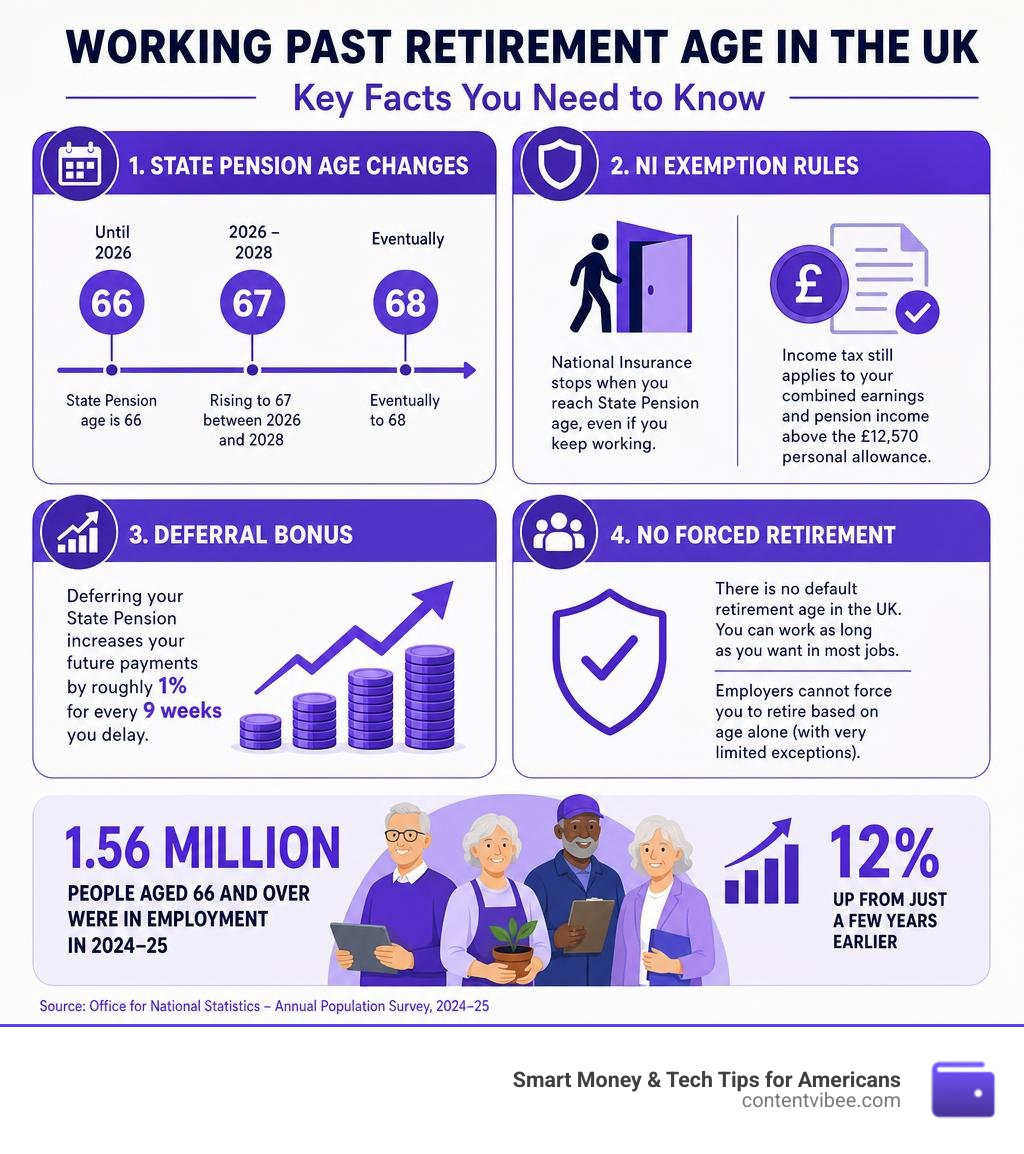
- No forced retirement: There is no default retirement age in the UK. You can work as long as you want in most jobs.
- State Pension age is currently 66 (rising to 67 between 2026 and 2028, and eventually to 68).
- You can claim your State Pension and keep working at the same time — no requirement to stop.
- National Insurance stops when you reach State Pension age, even if you keep earning.
- Income tax still applies to your combined earnings and pension income above the £12,570 personal allowance.
- Deferring your State Pension increases your future payments — by roughly 1% for every 9 weeks you delay.
- Employers cannot force you to retire based on age alone (with very limited exceptions).
The numbers tell a striking story. Around 1.56 million people aged 66 and over were in employment in 2024–25 — up 12% from just a few years earlier. Some are working by choice, for purpose and social connection. Others are working because they simply have to: the UK State Pension is the lowest among G7 nations, replacing less than a quarter of the average pre-retirement salary.
For Americans trying to understand how the UK system compares — especially around spousal benefits, earnings tests, and pension bonuses — the UK model offers some genuinely useful lessons.
Related content about working past retirement age uk:
Understanding the Rules of Working Past Retirement Age in the UK

Deciding when to hang up your working boots used to be straightforward. For decades, retirement was a “cliff-edge” event: men retired at 65, women at 60, and a gold carriage clock was waiting at the exit door.
Today, that predictable timeline has vanished. In the UK, the concept of a mandatory retirement age is a thing of the past. Under current legislation, you have the legal right to continue working for as long as you choose. According to the official guidelines on Working after State Pension age – GOV.UK, the default retirement age of 65 has been completely abolished.
This means that reaching your State Pension age does not mean you have to give up work. You can transition smoothly into a schedule that suits you, whether that means staying in your full-time role, scaling back to part-time hours, or launching a completely new career.
Current State Pension Age and Upcoming Changes
As of July 2026, the UK State Pension age stands at 66. However, this threshold is far from static. Due to rising life expectancies—which have climbed from an average of 71 years in 1960 to over 81 today—the government is gradually raising the pension age to keep the system financially sustainable.
Here is what the legislative roadmap looks like:
- The Rise to 67: The State Pension age is scheduled to increase to 67 between 2026 and 2028.
- The Rise to 68: Under current plans, the age will rise further to 68 between 2044 and 2046, although review processes constantly evaluate whether this timeline should be accelerated.
For anyone planning their later years, understanding these shifting goalposts is essential. As detailed in the comprehensive guide on What age can I retire? | Legal & General, while you must wait until 66 (and soon 67) to access your state-funded pension, you can generally access personal or workplace pensions much earlier—currently from age 55, rising to 57 in April 2028.
The Pros and Cons of Working Past Retirement Age in the UK
Choosing to stay in the workforce is a deeply personal decision that carries both significant benefits and notable drawbacks.
The Advantages
- Mental and Physical Stimulation: Continuing to work keeps your brain active and provides a structured routine. Studies consistently show that retirement can sometimes lead to cognitive decline and physical isolation; staying employed helps combat this.
- Social Connections: The workplace is a major source of community. Continuing to work helps avoid the loneliness that often accompanies a sudden exit from professional life.
- Financial Boosting: Every extra year you work is another year you can build up your savings, leave your pension pots to grow, or even defer your State Pension for a higher payout.
The Disadvantages
- Burnout and Stress: Over half of UK workers over 50 report feeling highly stressed at work. If your job is physically demanding or highly stressful, staying on can take a toll on your health.
- The “Forced” Reality: While many choose to work for pleasure, millions do so out of sheer financial necessity. Rising utility bills, high food prices, and insufficient pension savings mean that retirement is simply not an option for everyone.
To explore the psychological and social benefits of staying active in your 60s and 70s, read our analysis on Not Ready For The Rocking Chair Why Seniors Are Staying In The Workforce/. For a broader perspective on whether continuing to work is right for your lifestyle, you can also check out the insights shared in Should you carry on working past retirement age?.
Financial Implications: Taxes, National Insurance, and the Deferral “Bonus”
If you decide to work past your State Pension age, your financial landscape changes dramatically. The tax rules shift in ways that can either save you thousands of pounds or land you with an unexpected tax bill if you don’t plan carefully.
To understand how your earnings are treated once you cross the State Pension threshold, let’s look at this comparison:
| Financial Category | Before State Pension Age | After State Pension Age |
|---|---|---|
| National Insurance (NI) | Paid on earnings above £12,570 (Class 1 or Class 4) | £0 (Exempt) |
| Income Tax Personal Allowance | £12,570 tax-free | £12,570 tax-free |
| State Pension Taxation | N/A (Not yet claiming) | Taxable (Counts towards personal allowance) |
| Workplace Pension Contributions | Subject to auto-enrolment rules | Optional (Can continue contributing up to age 75) |
This unique tax environment explains why the Number of state pensioners in work rises to 1.6 million has hit record heights. The exemption from National Insurance acts as an immediate pay rise for older employees.
How Continuing to Work Affects Your State Pension
You do not have to claim your State Pension the moment you turn 66. If you choose to delay claiming it, the UK government rewards you with a generous deferral “bonus.”
For every 9 weeks you delay claiming your State Pension, your weekly payout increases by 1%. Over a full year, this adds up to an approximate 5.8% increase in your pension amount for life.
For example, based on the full new State Pension of approximately £11,973 per year (£230.25 per week), deferring for just one year will permanently add around £694 extra per year to your pension. This is an incredibly effective way of boosting your guaranteed, inflation-linked income. For practical advice on navigating these choices, you can read more through Working in later life | Independent Age.
Tax Rules and National Insurance Exemptions
The most significant financial perk of working past retirement age uk is the National Insurance exemption. Once you reach State Pension age, you stop paying Class 1 (employee) or Class 2/4 (self-employed) National Insurance contributions.
However, this exemption does not always happen automatically on your payroll. To ensure your employer stops deducting NI from your paypacket, you must provide them with proof of your age. Acceptable documents include:
- A valid passport
- A birth certificate
- A State Pension award letter
Once your age is verified, your employer will adjust your payroll. If you are self-employed, your Class 4 NI contributions will continue until the end of the tax year in which you reach State Pension age, after which they drop to zero.
That while NI stops, Income Tax does not. Your State Pension is taxable. If you receive a State Pension of £11,973 and earn £20,000 from a part-time job, your total taxable income is £31,973. After subtracting your £12,570 Personal Allowance, you will owe 20% tax on the remaining £19,403, resulting in a tax liability of roughly £3,880. HMRC will typically adjust your PAYE tax code on your employment income to collect this tax automatically.
Financial Planning for Working Past Retirement Age in the UK
While some choose to work for mental stimulation, a stark financial reality forces many to remain employed. The UK State Pension is famously lean compared to international standards, replacing less than 25% of average pre-retirement earnings—the lowest replacement rate in the G7.
Consequently, 14.5% of UK pensioners (around 1.9 million people) live in relative income poverty. This financial pressure is compounded by modern housing trends: more pensioners are entering retirement renting privately or carrying interest-only mortgages into their 70s and 80s.
The human side of this trend is starkly highlighted in The middle-class pensioners forced to keep working into their 80s, which tells the stories of older adults working full-time hours just to pay for basic utilities and rent. Similarly, a report on how Over 70s working beyond retirement age over financial fears – BBC News highlights that without part-time or flexible earnings, many older couples would struggle to survive the rising cost of living.
Flexible Employment and Career Pivots for Older Workers

Retirement no longer has to be an “all-or-nothing” decision. Many older workers are choosing to ease into retirement via “bridge jobs”—temporary or part-time roles that bridge the gap between a high-stress career and full-time leisure. If you want to explore how these roles work, take a look at our guide on Bridge Jobs To Help You Ease Into Retirement/.
Flexible Working Options and Phased Retirement
Under UK employment law, all employees have the right to request flexible working arrangements from day one of their employment. For older workers, this opens up several excellent pathways:
- Phased Retirement: Gradually reducing your days from five to three, and eventually to one or two days a week.
- Job Sharing: Splitting a full-time role with another colleague to keep your hand in the industry without the full-time commitment.
- Remote Work: Eliminating the daily commute by working from home. This is particularly popular in administrative and support roles. For example, you can learn How To Land Remote Retirement Customer Service Jobs/ to earn a comfortable income from your living room.
Finding New Roles and Starting a Business Later in Life
For many, later life is the perfect time for a career pivot. Free from the pressure of climbing the corporate ladder, you can focus on work that genuinely interests you.
Some of the most rewarding pathways include:
- Post-Retirement Consulting: Capitalising on decades of industry experience to work on your own terms. Learn How To Work On Your Own Terms With Post Retirement Consulting/.
- Digital Marketing: A highly flexible, creative field that can easily be managed from home. Read more about making a Late Career Pivot Finding Retirement Digital Marketing Jobs/.
- Active Community Roles: If you want to stay physically active while earning, check out our list of The Absolute Best Jobs After Retirement To Keep You Active/.
Whether you choose to work as a freelance consultant, a part-time tax preparer, or start an online business, the opportunities to design a custom work-life balance are virtually limitless.
Frequently Asked Questions About Retiring Later
Can my employer force me to retire in the UK?
In almost all cases, no. The Equality Act 2010 protects workers from age discrimination. An employer cannot force you to retire simply because you have reached State Pension age.
There are very rare exceptions where a “compulsory retirement age” can be objectively justified—such as in highly physical roles (like the fire service or construction) or where there are strict legal age limits (such as air traffic control). Otherwise, forcing you out based on your age is unlawful.
How many hours can I legally work after State Pension age?
There is no legal limit on the number of hours you can work after reaching State Pension age. The standard UK Working Time Regulations still apply (which cap the average working week at 48 hours unless you choose to opt out), but there are no age-specific restrictions on your working hours.
Does working past retirement age affect my workplace pension?
No. You can continue to contribute to a workplace pension past your State Pension age, and your employer must continue to match your contributions if you remain auto-enrolled (up to the age of 75).
If you choose to access your workplace pension while continuing to work, check with your provider first, as some schemes have specific rules regarding “phased drawdown” or may tax your withdrawals if your total combined income pushes you into a higher tax bracket.
Conclusion
At ContentVibee, we believe that modern retirement planning is all about flexibility, choice, and financial empowerment. Working past retirement age uk is no longer a sign of a failed retirement plan; for many, it is a deliberate and rewarding lifestyle choice that keeps the mind sharp, the social circle wide, and the bank balance healthy.
Whether you are looking to defer your State Pension to secure a lifetime “bonus,” transition into a remote consulting role, or simply understand how your taxes will change, taking control of your financial education is the first step.
Are you curious about how working in retirement affects your family’s overall financial security? Read our detailed breakdown: Are spousal benefits reduced by working? to make sure you are maximizing every single penny you and your partner have worked hard to earn.