


Social Security Spousal Benefits: What You’re Entitled To (Quick Answer)
Are spouses entitled to Social Security benefits? Yes — and it can mean hundreds of extra dollars every month in retirement.
Here’s the short version of who qualifies:
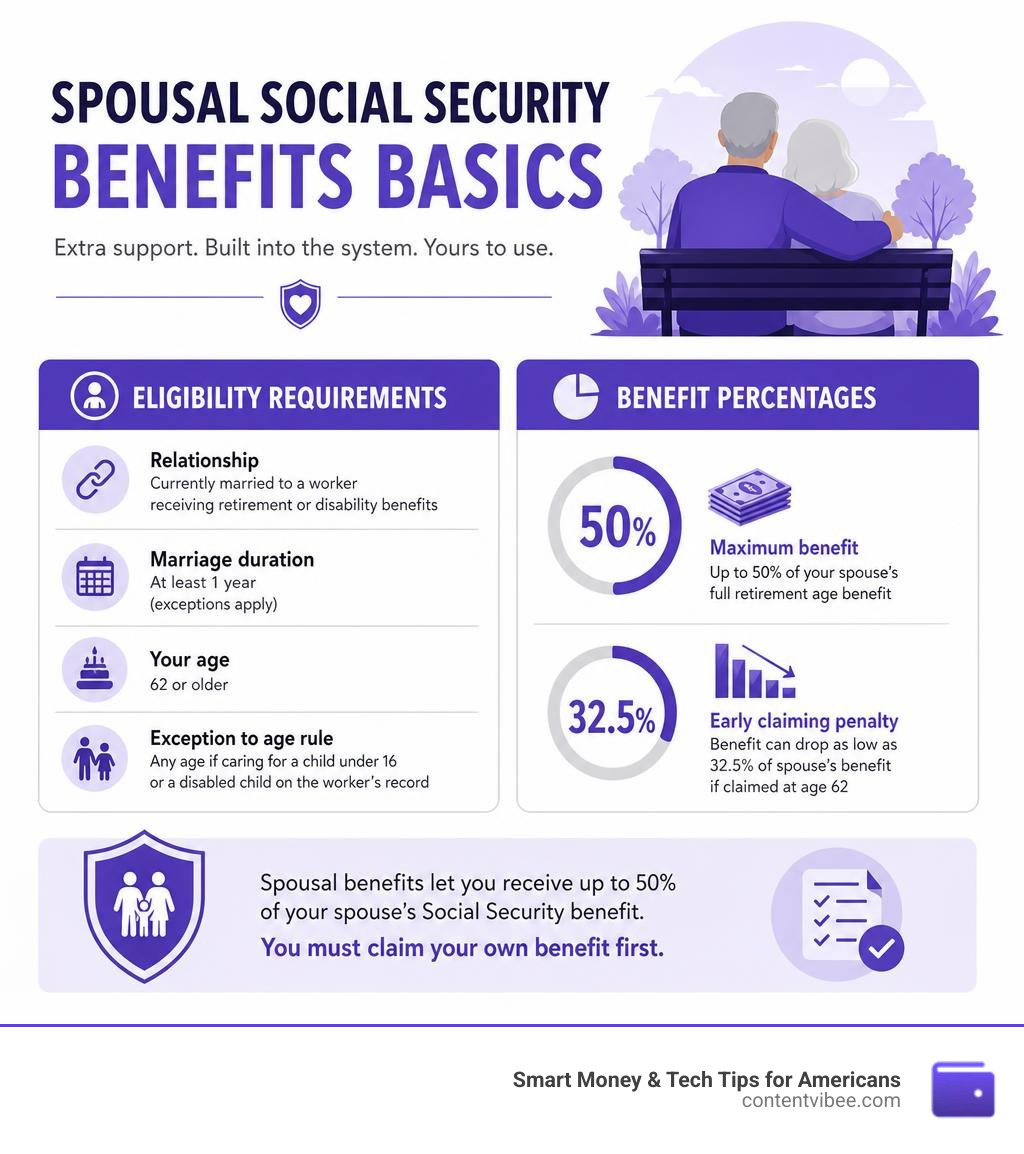
| Requirement | Details |
|---|---|
| Relationship | Currently married to a worker receiving retirement or disability benefits |
| Marriage duration | At least 1 year (exceptions apply) |
| Your age | 62 or older |
| Exception to age rule | Any age if caring for a child under 16 or a disabled child on the worker’s record |
| Maximum benefit | Up to 50% of your spouse’s full retirement age benefit |
| Early claiming penalty | Benefit can drop as low as 32.5% of spouse’s benefit if claimed at 62 |
If you’re divorced, different rules apply — but you may still qualify. And if your spouse has passed away, survivor benefits offer even higher potential payouts.
Millions of Americans leave money on the table simply because they don’t know these rules exist. Social Security spousal benefits are one of the most valuable — and most misunderstood — parts of the entire retirement system.
The rules around eligibility, timing, and benefit amounts can feel complicated. But once you understand a few core principles, the path becomes much clearer.
This guide breaks down everything you need to know: who qualifies, how much you can get, when to claim, and what the special rules mean for divorced or widowed spouses.
Are Spouses Entitled to Social Security Benefits? Eligibility Rules Explained

When we sit down to map out our golden years, we often focus entirely on our own work histories. But the Social Security Administration (SSA) recognizes that marriage is a financial partnership. If you are married, the short answer is yes: you may be eligible to receive monthly payments based on your partner’s earnings history.
To determine if you meet the baseline requirements, the SSA looks at several factors, which we outline in The Ultimate Guide to Spousal Social Security Eligibility. Let’s walk through the core criteria:
- The Marriage Milestone: To qualify for standard spousal benefits, you must have been married to your spouse for at least one continuous year at the time you apply.
- The Age Requirement: You must generally be at least 62 years old to claim spousal benefits.
- The Worker’s Status: Your spouse must already be receiving their own retirement or disability benefits for you to collect on their record.
These rules form the foundation of family-based entitlements. If you are unsure whether your marriage duration or current status fits the bill, you can learn How to Check Your Eligibility for Spousal Social Security Benefits or review the official guidelines on Family benefits | SSA.
Legal Marriage and Deemed Spouse Rules
The definition of a “spouse” isn’t always as simple as presenting a wedding album. The SSA determines the validity of a marriage based on the laws of the worker’s state of domicile at the time the application is filed.
But what happens if there is a legal hiccup? This is where the concept of a “deemed spouse” comes into play. Under federal policy detailed in SSA – POMS: RS 00202.001, if you entered into a marriage ceremony in good faith, but a legal impediment (such as an administrative error in a prior divorce) prevents it from being legally valid, the SSA can “deem” you to be a spouse. This ensures that honest mistakes don’t strip away your hard-earned retirement security.
Additionally, the one-year marriage requirement has a few flexible workarounds. For instance, if you are the natural parent of your spouse’s biological child, or if you were entitled (or potentially entitled) to certain Social Security or Railroad Retirement benefits in the month before your marriage, the one-year waiting period may be waived. You can explore these intricate legal definitions in the SSA Handbook § 305.
The Child-in-Care Exception to Age Requirements
Are there situations where you can bypass the age 62 requirement entirely? Yes! This is known as the “child-in-care” exception.
If you are caring for a child who is under the age of 16, or a child of any age who became disabled before age 22, you can claim spousal benefits at any age. The child must be entitled to child’s insurance benefits on your spouse’s record.
Importantly, if you claim spousal benefits early under this caregiving exception, your benefit is not reduced for early claiming. It remains a full, unreduced benefit for as long as you have the qualifying child in your care. For a deeper look at how this caregiving rule operates, check out The Golden Rules: Can a Spouse Collect SS Spousal Benefits.
How Spousal Benefits Are Calculated and the Impact of Early Claiming

Now that we know who qualifies, let’s talk about the fun part: the money.
The maximum spousal benefit you can receive is 50% of your partner’s Primary Insurance Amount (PIA). Your partner’s PIA is the monthly benefit they are entitled to receive at their Full Retirement Age (FRA)—which is 67 for anyone born in 1960 or later.
For example, if your spouse’s PIA is $2,000, your maximum spousal benefit is $1,000. It is important to note that your spousal benefit is capped at this 50% mark. Even if your spouse delays claiming their own benefit past their FRA to earn delayed retirement credits (boosting their own check up to age 70), your spousal benefit calculation will still be based on their FRA amount.
To see how these numbers shake out for your specific household, we recommend reading Determining Your Spousal Social Security Benefit Amount or using our guide to Calculate Your Spousal Benefits the Easy Way. You can also run official estimates directly through the Benefits for Spouses – Social Security Administration page.
The Cost of Claiming Early: Reduction Factors
While you can choose to claim spousal benefits as early as age 62, doing so comes with a permanent financial haircut.
If you claim before your own Full Retirement Age, the SSA applies a monthly reduction factor to your spousal benefit:
- For the first 36 months before your FRA, your benefit is reduced by 25/36 of 1% for each month.
- For any additional months beyond 36 months (up to a maximum of 60 months if your FRA is 67), the benefit is reduced by an additional 5/12 of 1% per month.
If your FRA is 67 and you claim at exactly age 62, your benefit will be reduced by a whopping 35%. This means instead of getting 50% of your spouse’s PIA, you will only receive 32.5% of their PIA.
Before making this choice, it is vital to ask: At What Age Can I Claim My Spouses Social Security? To help you run the math on these reduction percentages, we have put together a step-by-step walkthrough on How to Calculate Your Spousal Retirement Age Easily.
Spousal Benefit Percentages by Claiming Age
To make these reduction factors easier to visualize, here is a breakdown of what percentage of your spouse’s PIA you can expect to receive based on how early you claim (assuming a Full Retirement Age of 67):
| Age at Claim | Months Early | Reduction Percentage | Your Final Benefit (As % of Spouse’s PIA) |
|---|---|---|---|
| 67 (FRA) | 0 | 0.0% | 50.0% |
| 66 | 12 | 8.33% | 45.83% |
| 65 | 24 | 16.67% | 41.67% |
| 64 | 36 | 25.0% | 37.5% |
| 63 | 48 | 30.0% | 35.0% |
| 62 | 60 | 35.0% | 32.5% |
As this table shows, patience pays off. Claiming early permanently shrinks your monthly check, which is why Social Security Spousal Benefits: Timing Is Everything.
Navigating Dual Entitlement and Filing Rules
A common point of confusion is how your own work history interacts with spousal benefits. Many people wonder: Can I collect my own retirement benefit and a spousal benefit at the same time?
The short answer is no, you cannot “double dip” to receive two full checks. Instead, the SSA operates under a rule called dual entitlement. If you qualify for both your own retirement benefit and a spousal benefit, the SSA will pay your own benefit first. If your spousal benefit is higher than your own retirement benefit, they will add a supplemental payment to make up the difference.
Let’s look at a quick example. Meet Sandy. Sandy’s own retirement benefit at FRA is $1,000. Her husband’s retirement benefit at FRA is $2,500, which makes her maximum spousal benefit $1,250.
- When Sandy files, the SSA pays her own $1,000 retirement benefit first.
- Because her spousal entitlement ($1,250) is higher, she receives a supplemental spousal payment of $250.
- Her total monthly check is $1,250.
To understand how these overlapping benefits are structured, check out His, Hers, and Ours: The Ultimate Guide to Dual Social Security Benefits and find out if Can a Married Couple Both Collect Social Security.
Are Spouses Entitled to Social Security Benefits if They Also Worked?
Yes, working spouses are absolutely entitled to benefits, but the math depends heavily on whose record yields the higher payout. If your own retirement benefit is higher than 50% of your spouse’s benefit, you will simply receive your own higher retirement benefit.
If you plan on working while collecting a spousal benefit before reaching your Full Retirement Age, be aware of the SSA’s annual earnings test. Earning over the annual limit can temporarily reduce your benefits. For a comprehensive strategy on managing work and retirement benefits simultaneously, read Double Dipping: The Working Spouses Guide to Social Security and review the official blog post Do You Qualify for Social Security Spouse’s Benefits?.
Deemed Filing and File-and-Suspend Rules
If you are planning your claiming strategy, you must understand the “deemed filing” rules established by the Bipartisan Budget Act of 2015.
Before this law, couples could use a strategy where one spouse filed for a “restricted application,” allowing them to collect only spousal benefits while letting their own retirement benefit grow by 8% per year up to age 70.
Today, that loophole is closed for anyone who turned 62 after January 2, 2016. Under deemed filing, when you file for either your own retirement benefit or a spousal benefit, you are deemed to have filed for both. The SSA will automatically calculate both and pay you the higher amount. You can no longer choose to receive only the spousal benefit while delaying your own.
Similarly, the old “file-and-suspend” strategy has been restricted. If a worker suspends their retirement benefits to earn delayed retirement credits, any spousal benefits flowing from their record are also suspended.
These rules require couples to coordinate their claiming dates carefully. We explore these modern rules in The Smart Couples Guide to Social Security Strategies. You can also read about advanced coordination techniques on the Social Security Strategies for Married Couples – Vanguard page.
Divorced Spouse and Survivor Benefits: Special Rules
Life doesn’t always follow a straight line, and the Social Security system has built-in safety nets for divorces and the loss of a partner. Both divorced spouses and surviving spouses have access to distinct benefit structures.
For a high-level overview of how these family dynamics shift your planning, see How Social Security Spousal Benefits Work for Married Couples and A Comprehensive Guide to Social Security Benefits.
How Divorced Spouses Are Entitled to Social Security Benefits
If you are divorced, you may still be entitled to receive up to 50% of your ex-spouse’s benefit record. To qualify, you must meet the following criteria:
- Your marriage lasted for at least 10 years.
- You are currently unmarried (if you remarry, you generally lose eligibility for benefits on your ex-spouse’s record, unless your subsequent marriage ends).
- You are age 62 or older.
- Your ex-spouse is eligible for retirement or disability benefits (even if they haven’t applied yet, as long as you have been divorced for at least two continuous years).
The beauty of divorced spouse benefits is that they are entirely confidential. Your ex-spouse is not notified when you apply, and your claim has absolutely zero impact on their monthly benefit or any benefit their current spouse might claim. These protections are formally codified under Social Security Act §202.
Survivor Benefits vs. Spousal Benefits
While spousal benefits max out at 50% of a living worker’s benefit, survivor benefits are much more generous. If your spouse passes away, you can inherit up to 100% of their monthly Social Security payment.
Here is how survivor benefits differ from spousal benefits:
- Age Eligibility: You can claim survivor benefits as early as age 60 (or age 50 if you are disabled).
- Payout Percentage: If you wait until your own Full Retirement Age for survivors, you will receive 100% of the deceased worker’s benefit. If you claim at age 60, the benefit is reduced to 71.5%.
- Remarriage Rules: If you remarry after age 60 (or after age 50 if disabled), your remarriage will not affect your eligibility for survivor benefits.
Because survivor benefits can be significantly larger than spousal benefits, they represent a critical piece of long-term financial security. We outline how to coordinate these options in Show Me the Money: How to Maximize Your Spouses Retirement Cash.
Frequently Asked Questions about Spousal Benefits
Can I collect spousal benefits if my spouse hasn’t filed yet?
If you are currently married, no. Your spouse must be actively receiving their own retirement or disability benefits for you to claim spousal benefits on their record.
However, if you are divorced and have been divorced for at least two consecutive years, you can claim benefits as an “independently entitled divorced spouse” even if your ex-spouse has not yet filed, provided they are at least 62 and eligible to receive benefits. If you are ready to take this step, you can learn how to Claim Spousal Benefits.
Does my spousal benefit reduce my partner’s retirement check?
No, absolutely not. Any spousal or divorced spouse benefits paid out on a worker’s record are paid in addition to the worker’s own benefit. Your spouse will still receive their full monthly retirement check.
Additionally, benefits paid to a divorced spouse do not count toward the “family maximum” limit, meaning they will not reduce the benefits of a worker’s current spouse or children. For more peace of mind on this topic, read Double the Fun: A Guide to Social Security Spousal Benefits for Couples.
How do I apply for spousal benefits?
The easiest way to apply is online at the official SSA website, provided you are at least 61 years and 9 months old. You can also apply by phone at 1-800-772-1213 or in person at your local Social Security office.
Be prepared to provide documents such as your marriage certificate, birth certificate, proof of citizenship, and potentially your ex-spouse’s Social Security number if you are filing as a divorced spouse. You can find a complete checklist in our guide on Applying for Spousal Benefits.
Conclusion
At ContentVibee, we believe that maximizing your retirement income shouldn’t feel like deciphering a secret code. Understanding whether are spouses entitled to social security benefits—and knowing how to time your claim—can make a massive difference in your household’s lifetime wealth.
By coordinating your claiming ages, understanding the dual entitlement rules, and keeping an eye on reduction factors, you and your partner can build a robust, predictable stream of retirement income.
Ready to optimize your strategy? Check out The Ultimate Guide to Social Security Benefit Optimization and use our interactive Tools/Finance Calculator/Social Security Spousal Benefit Calculator to run your household’s custom numbers today!


