


Why the Best Tax Friendly States Can Save You Thousands in Retirement
The best tax friendly states can mean the difference between a comfortable retirement and one where taxes quietly drain your savings year after year.
Here is a quick look at the top states by overall tax burden in 2026:
| Rank | State | No Income Tax? | Avg. Total Tax Burden |
|---|---|---|---|
| 1 | Wyoming | Yes | ~7.5% |
| 2 | South Dakota | Yes | ~7.37% |
| 3 | Alaska | Yes | ~5.16% |
| 4 | New Hampshire | Yes (as of 2025) | ~6.8% |
| 5 | Florida | Yes | ~8.0% |
Nine states collect no personal income tax at all: Alaska, Florida, Nevada, New Hampshire, South Dakota, Tennessee, Texas, Washington, and Wyoming. For retirees living on Social Security, pension income, or 401(k) withdrawals, moving to one of these states can save thousands of dollars every year.
But income tax is only one piece of the puzzle.
A single filer earning $100,000 in Oregon faces a combined effective tax rate of 28.06% — the highest in the country. Move that same person to a no-income-tax state, and the rate drops to 21.06%. That is roughly $7,000 back in your pocket, every year.
Still, states without income taxes often make up the revenue elsewhere — through higher property taxes, sales taxes, or other fees. Tennessee has no income tax but carries the highest average combined sales tax in the nation at 9.55%. New Hampshire has no income tax and no sales tax, but its property tax rate of around 2.05% is the steepest in the Northeast.
The smartest move is to look at the full picture before deciding where to plant your retirement roots.
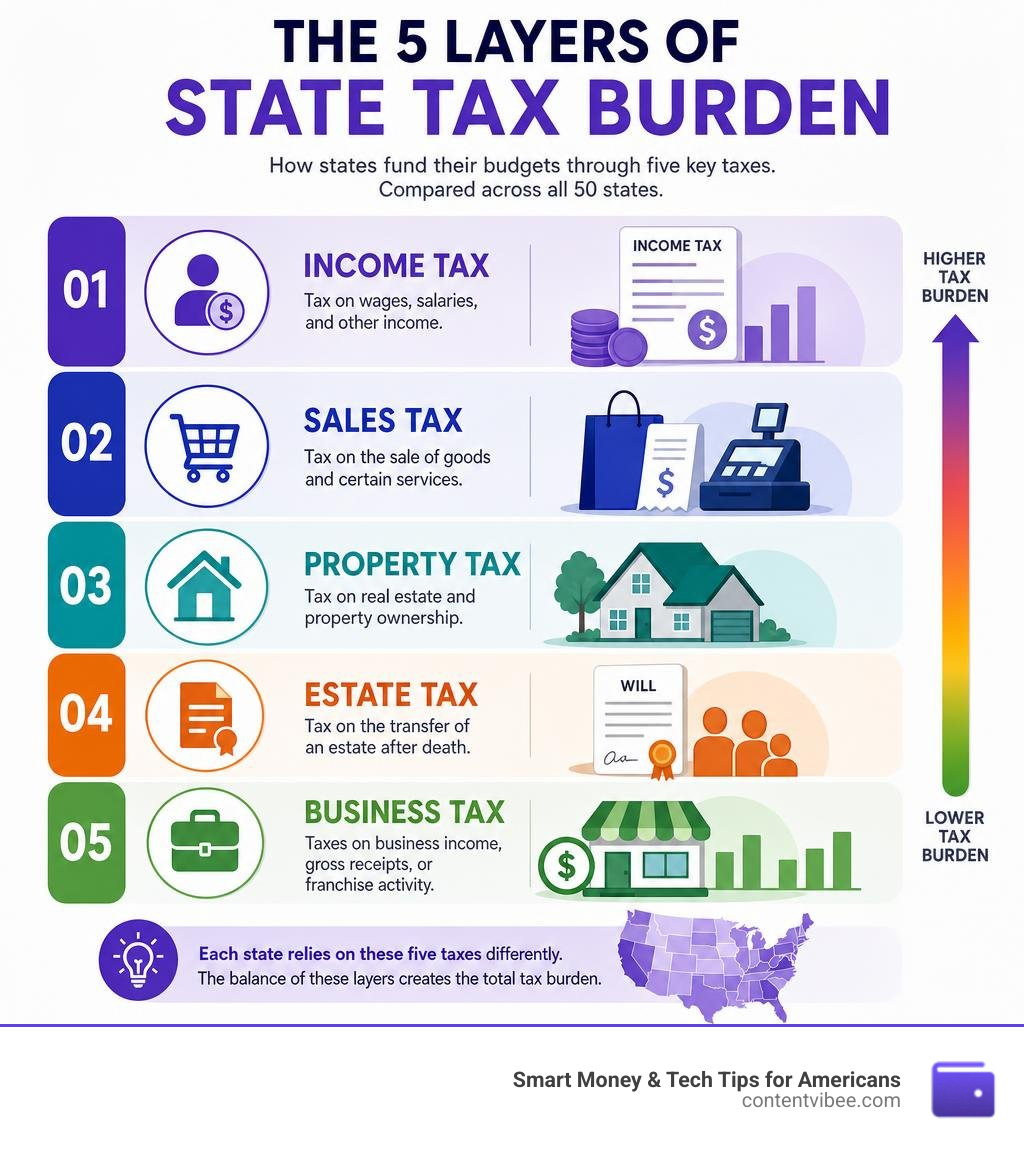
Best tax friendly states vocab to learn:
Evaluating the Best Tax Friendly States for Overall Burden
When we search for the best tax friendly states, it is easy to get hyper-focused on a single number—usually the state income tax rate. However, focusing solely on income tax is a significant analytical error. To truly understand how a state will impact your wallet, we must look at the overall tax burden.
A state’s total tax burden measures the percentage of personal income that residents pay in state and local taxes, including income, sales, property, and corporate taxes. According to the 2026 State Tax Competitiveness Index: Interactive Tool, Wyoming ranks #1 overall in tax competitiveness, closely followed by South Dakota (#2) and New Hampshire (#3).
These top-performing states excel because they maintain structurally balanced, low-rate tax systems. Rather than relying heavily on one massive tax type that penalizes productivity, they spread their revenue needs across smaller, less intrusive levies or benefit from unique natural resource revenues.

For example, Alaska has no state income tax and no state sales tax, allowing it to maintain the lowest overall tax burden in the nation at just 5.16% of personal income. Conversely, states like New York rank dead last (#50 overall) due to high, progressive income taxes topping out at 10.9%, combined with high local sales taxes and heavy property tax burdens, leading to an average total tax burden of approximately 15.9%.
The Nine States with No Personal Income Tax
For many taxpayers, the ultimate tax-friendly status belongs to the states that do not levy a personal income tax. As of July 2026, there are nine states with no broad-based personal income tax: Alaska, Florida, Nevada, New Hampshire, South Dakota, Tennessee, Texas, Washington, and Wyoming.

While these nine states all share a 0% individual income tax rate, they fund their public services in vastly different ways. This means that a “no-income-tax” state is not automatically a low-tax state for every household budget.
Why Florida and Texas Rank as the Best Tax Friendly States for High Earners
Florida and Texas have long been the premier destinations for high-earning W-2 employees, business founders, and retirees. In 2024 alone, Florida gained over 760,000 residents, while high-tax California lost 466,000. Much of this migration is driven by the sheer mathematical savings available to high earners.
For instance, a high earner bringing in $500,000 per year in California faces a top marginal tax rate of 13.3%, resulting in over $66,000 in state income taxes annually. By establishing legal domicile in Florida or Texas, that annual state income tax bill drops to zero.
- Florida is exceptionally friendly to retirees and wealth builders alike. Beyond having zero income tax, it offers a robust homestead exemption that reduces the taxable value of a primary residence by up to $50,000. It also has no state estate or inheritance tax, making it a premier location for wealth preservation.
- Texas offers massive income tax savings, but homeowners must prepare for a major caveat: property taxes. Texas has the 6th-highest property tax rate in the nation, averaging about 1.60% to 1.74% of a home’s value. While a $100,000 school district exemption helps ease the pain, a homeowner with a high-value property may find that their property tax bill eats up a significant portion of their income tax savings.
To successfully secure these savings, you must legally establish domicile. This requires more than just buying a condo; you must obtain a new driver’s license, register to vote, update your estate planning documents, and file an official Declaration of Domicile in your new home county.
How Washington and New Hampshire Differ from Other Best Tax Friendly States
Washington and New Hampshire are often categorized as no-income-tax states, but they carry unique rules that set them apart from the rest of the pack.
- Washington does not tax W-2 wage income, making it highly attractive for corporate employees. However, it carries an asterisk for investors and business owners. Washington levies a 7% capital gains excise tax on long-term capital gains exceeding $278,000 (excluding real estate sales). Additionally, the state has scheduled a 9.9% millionaire income tax to take effect in 2028. While Washington remains an excellent tax haven for wage earners, high-net-worth investors must tread carefully.
- New Hampshire became a fully income-tax-free state on January 1, 2025, after completely repealing its long-standing Interest and Dividends Tax. It also boasts a 0% state sales tax. However, New Hampshire offsets these perks by maintaining the highest property tax rate in the Northeast, averaging around 2.05%. For renters or those living in modest homes while surviving on investment portfolios, New Hampshire is an absolute tax paradise. For those planning to purchase a multi-million-dollar estate, the property tax bills can be eye-watering.
Retirement Tax Friendliness: Social Security, Pensions, and 401(k)s
Choosing where to spend your golden years requires a deep dive into how different states tax retirement income. Even states that impose an income tax can end up being highly tax-friendly for seniors if they offer generous exclusions for retirement pay.

Before packing your bags, we must evaluate how your specific retirement income streams—such as Social Security, private pensions, and traditional 401(k) or IRA withdrawals—will be treated. If you are looking to optimize your retirement assets, check out our guide on Smart Strategies to Defer Taxes and Boost Your Retirement Savings and compare your options using our analysis of Pension vs 401k Tax Strategies for Working Retirees.
States That Exempt Social Security and Pension Income
As of 2026, the vast majority of U.S. states do not tax Social Security benefits. Only eight states still levy a tax on Social Security income: Colorado, Connecticut, Minnesota, Montana, New Mexico, Rhode Island, Utah, and Vermont. Recent policy changes have seen states like West Virginia fully phase out their Social Security taxation as of 2026, while Missouri, Kansas, and Nebraska eliminated their taxes over the preceding years.
For more details on how the federal government and various states look at your benefits, refer to our comprehensive guides:
- Taxing Your Golden Years: A Guide to Social Security Tax on Benefits
- Social Security Taxable Income Guide 2026
Beyond Social Security, several income-taxing states offer massive retirement income exclusions:
- Georgia: Taxpayers aged 62 to 64 can exclude up to $35,000 of retirement income, and those aged 65 or older can exclude up to $65,000 per person ($130,000 for a married couple) from state income taxes. This exclusion applies to pensions, interest, dividends, and IRA distributions.
- Pennsylvania: Despite having a flat 3.07% income tax rate, Pennsylvania is incredibly tax-friendly for retirees. The state completely exempts all traditional retirement income, including private pensions, IRA withdrawals, and 401(k) distributions, provided you have reached eligible retirement age.
- Alabama: Alabama exempts all defined benefit pension income and Social Security benefits from state income taxes. It also has some of the lowest property taxes in the nation, making it a sleeper hit for budget-conscious retirees.
Beyond Income Tax: Property, Sales, and Estate Taxes
To find the absolute best tax friendly states for your unique financial profile, we must look beyond income tax and evaluate property, sales, and wealth transfer taxes.
Property Tax Relief and Senior Exemptions
Property taxes are a recurring annual expense that can easily outpace income tax liabilities, especially for retirees on fixed incomes who own their homes outright.
- Hawaii has the lowest effective property tax rate in the country at just 0.29%, meaning a $500,000 home incurs only about $1,450 in annual property taxes.
- Alabama is the second-lowest with an effective property tax rate of 0.37%, resulting in a median annual property tax bill of just $890.
- New Jersey sits at the opposite end of the spectrum, carrying the highest median property tax in the nation at $9,358 annually.
Fortunately, many states offer senior property tax relief programs, including homestead exemptions, senior freeze programs (which lock in the assessed value of a senior’s home), and property tax deferrals that allow seniors to delay payments until the home is eventually sold. For those moving from high-tax regions, understanding these adjustments is crucial. You can read more about navigating complex state adjustments in The Golden State Guide: Deciphering CalPERS COLA and California Tax Adjustments.
Sales Tax and Estate Tax Considerations
Sales taxes directly reduce your daily purchasing power. If you live on a fixed retirement budget, a high local sales tax can quietly erode your lifestyle.
- Louisiana has the highest average combined state and local sales tax rate at 10.11%, followed closely by Tennessee at 9.61%. If you spend $50,000 a year on taxable goods in Tennessee, you will pay over $4,800 in sales tax alone.
- Conversely, Delaware, Montana, New Hampshire, and Oregon levy no state or local sales taxes, giving consumers a major break at the register.
Finally, high-net-worth families must consider estate and inheritance taxes. While the federal estate tax exemption is a generous $15 million in 2026, twelve states and the District of Columbia impose their own estate taxes with much lower thresholds. Oregon has the lowest estate tax exemption in the country at just $1 million, meaning moderate-income families who own real estate can easily trigger state-level estate taxes upon death. Six states also maintain an inheritance tax, which taxes the beneficiaries of an estate rather than the estate itself.
Frequently Asked Questions about State Tax Burdens
Which state has the absolute lowest total tax burden in 2026?
Alaska has the absolute lowest total tax burden in 2026, estimated at just 5.16% of personal income. Alaska has no state income tax, no state sales tax, and moderate property taxes. Best of all, Alaska actually pays its residents an annual Permanent Fund Dividend (typically ranging from $1,300 to $2,000 per person) funded by the state’s oil revenues.
Can my former state still tax me after I relocate?
Yes, if you do not properly sever your ties. High-tax states like California and New York aggressively audit former residents who claim to have relocated to no-income-tax states like Florida or Texas. To survive a residency audit, you must prove that your “closest connections” have moved. This means spending fewer than 183 days in your former state, selling or renting out your primary residence there, moving your bank accounts, and updating your professional licenses.
For those planning their exit from the West Coast, timing is everything. Read our guide on When Can You Stop Working and Retire in California to plan your transition strategically.
Does a flat tax system benefit middle-class taxpayers more than a progressive system?
It depends on your income level. In a progressive tax system (like California or Oregon), tax rates increase as your income rises, which benefits lower-income and middle-class taxpayers while heavily taxing high earners. In a flat tax system (like Pennsylvania’s 3.07% or Illinois’ 4.95%), everyone pays the exact same rate regardless of income.
For middle-class families earning around $100,000, flat-tax states or low-rate progressive states often offer a lower combined effective tax rate than highly progressive states, where middle-class brackets can start surprisingly low.
Conclusion
At ContentVibee, we believe that optimizing your tax strategy is one of the most effective ways to secure your financial future. Finding the best tax friendly states is not about chasing a single 0% income tax rate; it is about looking at the total picture—balancing income, property, sales, and estate taxes against your personal lifestyle and retirement goals.
Whether you are looking to relocate to a tax haven, optimize your business structure, or protect your hard-earned retirement savings, we are here to provide clear, actionable personal finance tips to help you make smart money decisions.
For more insights on keeping more of what you earn in retirement, read our essential guide: Uncle Sam’s Cut: Understanding Taxes on Social Security.