


Why the Inherited IRA Rollover Deadline Catches So Many Beneficiaries Off Guard
The inherited IRA rollover deadline is one of the most misunderstood rules in retirement planning — and missing it can trigger a tax bill that wipes out a significant chunk of your inheritance.
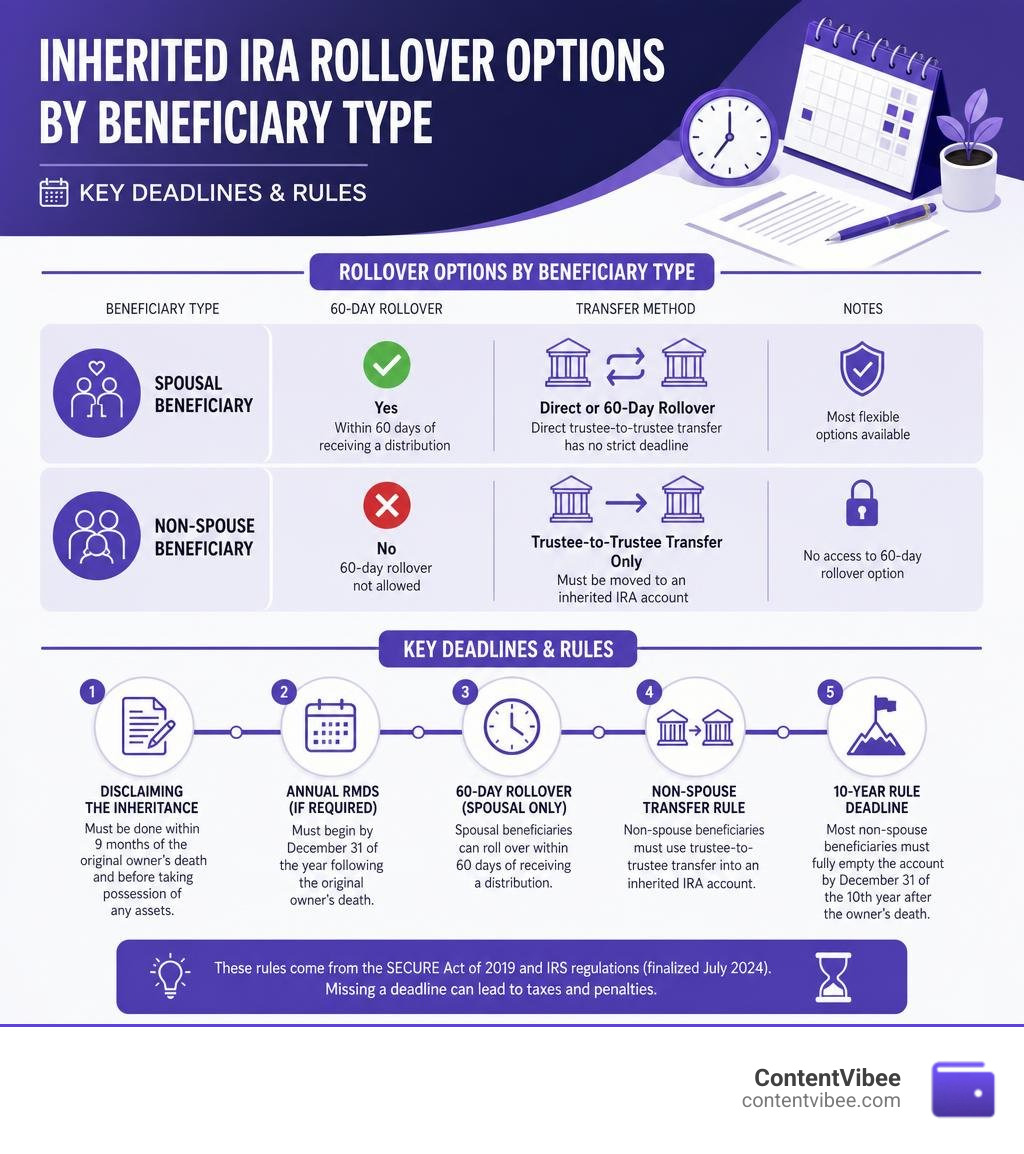
Here is a quick summary of the key deadlines and rules:
- Spousal beneficiaries: Can roll over an inherited IRA into their own IRA within 60 days of receiving a distribution, or complete a direct trustee-to-trustee transfer with no strict deadline
- Non-spouse beneficiaries: Cannot do a 60-day rollover at all — assets must move via trustee-to-trustee transfer into an inherited IRA account
- Disclaiming the inheritance: Must be done within 9 months of the original owner’s death, and before taking possession of any assets
- Annual RMDs (if required): Must begin by December 31 of the year following the original owner’s death
- 10-year rule deadline: Most non-spouse beneficiaries must fully empty the account by December 31 of the 10th year after the owner’s death
These rules changed significantly after the SECURE Act of 2019, and the IRS finalized updated regulations as recently as July 2024. With roughly $16.8 trillion held in U.S. IRAs today, a massive amount of wealth is passing to heirs who often don’t know the rules — until it’s too late.
Consider this scenario: a parent passes away in 2021 at age 74, leaving behind a $500,000 traditional IRA. The heir takes nothing out, assuming the IRS penalty waivers are permanent. They aren’t. Those waivers expired after 2024, and penalties resumed in 2025.
Getting the rollover process right from day one matters — a lot.
Relevant articles related to inherited ira rollover deadline:
Understanding the Inherited IRA Rollover Deadline and Key Timelines
When we talk about the inherited IRA rollover deadline, we have to separate standard IRA rules from the unique regulations governing inherited assets.
For a standard, non-inherited IRA, you have the flexibility of the 60-day rollover rule. This allows you to take a physical check from your retirement account and deposit it into another eligible plan within 60 days without facing taxes or penalties. You are also limited to only one indirect rollover per 12-month period across all of your IRAs.
However, for inherited IRAs, the rules are far stricter:
- The 60-Day Rule is Spouses-Only: Only a surviving spouse is allowed to perform an indirect, 60-day rollover of inherited retirement assets.
- The Trustee-to-Trustee Requirement: For non-spouse beneficiaries, an indirect rollover is completely prohibited. If you receive a check made out in your name from an inherited IRA, the IRS views that as a permanent, taxable distribution. You cannot deposit those funds into an inherited IRA. Instead, the money must move directly via a trustee-to-trustee transfer.
- The December 31 Deadline for Account Setup: If an IRA has multiple beneficiaries, the account must be split into separate inherited IRAs by December 31 of the year following the year of the owner’s death. Failing to split the account by this deadline means all beneficiaries must use the life expectancy of the oldest beneficiary to calculate Required Minimum Distributions (RMDs), which can severely accelerate tax liabilities for younger heirs.
To understand how these transfer methods differ from standard retirement plan moves, you can read the official IRS guide on rollovers of retirement plan and IRA distributions. Additionally, if you are transitioning other types of accounts, such as an employer plan, you might find our guide on how long you have to rollover a 401k after quitting highly useful.
Spousal vs. Non-Spouse Beneficiary Rollover Rules
The IRS divides IRA heirs into two major camps: surviving spouses and non-spouse beneficiaries (such as children, siblings, or friends). Your options, timelines, and tax burdens depend entirely on which category you fall into.
| Feature | Surviving Spouse Beneficiary | Non-Spouse Beneficiary |
|---|---|---|
| Rollover to Own IRA? | Yes, fully allowed | No, strictly prohibited |
| 60-Day Indirect Rollover? | Yes, permitted | No, must use direct transfer |
| Account Type Required | Own IRA or Inherited IRA | Inherited IRA (Beneficiary Distribution Account) |
| 10-Year Liquidation Rule? | No (unless inheriting from a trust) | Yes, for most non-spouse heirs |
| Penalty-Free Access < 59½? | Only if kept as an Inherited IRA | Yes, always penalty-free (but taxable) |
If you are currently managing other complex plan transfers, such as moving a 403(b), check out our comprehensive 403b rollover guide to master your retirement account move.
Spousal Rollover Options and the Inherited IRA Rollover Deadline
If you inherit an IRA from your spouse, you have the greatest degree of flexibility. You can choose between two primary paths:
- Treat the IRA as Your Own (Spousal Rollover): You can roll the assets into your existing IRA or a new IRA in your name. Once you do this, the account is treated as if you had owned it all along. Your RMDs will be based on your age, starting at age 73 (or age 75 if you reach 73 after December 31, 2032). The inherited IRA rollover deadline for a spousal indirect rollover is 60 days from the date you receive the distribution. However, a direct trustee-to-trustee transfer has no strict deadline.
- Treat the IRA as an Inherited IRA: You can transfer the funds into an Inherited IRA (sometimes called a Beneficiary Distribution Account). This is often the best choice if you are under age 59½ and need to use the money. Withdrawals from an Inherited IRA are exempt from the 10% early withdrawal penalty, whereas withdrawals from your own IRA before age 59½ would trigger that penalty.
Many spouses eventually convert their inherited accounts into their own IRAs once they pass age 59½ to simplify their financial planning. If you are looking to move similar non-IRA accounts, our guide on how to roll a 403b into an IRA provides excellent step-by-step instructions.
Non-Spouse Beneficiary Restrictions and the Inherited IRA Rollover Deadline
If you inherit an IRA from anyone other than your spouse — such as a parent or grandparent — you cannot roll the assets into your own IRA.
You must establish a properly titled Inherited IRA. The account name must include the deceased owner’s name and indicate that it is an inherited account (for example: “John Doe, deceased, for the benefit of Jane Doe, beneficiary”).
Because you cannot perform a 60-day indirect rollover, any attempt to cash out the account with the intention of moving it later will result in an immediate tax disaster. The entire balance will be treated as ordinary income in the tax year you received the check, potentially pushing you into the highest federal tax bracket. All transfers must be executed directly between custodians.
How the SECURE Act and SECURE 2.0 Impact Inherited IRAs
The legislative landscape for inherited IRAs has shifted dramatically in recent years. The SECURE Act of 2019 eliminated the beloved “stretch IRA” strategy for most non-spouse beneficiaries inheriting accounts from owners who died on or after January 1, 2020.
Under the old rules, a young beneficiary could stretch distributions over their own natural life expectancy, allowing the account to grow tax-deferred for decades. Today, that strategy is largely gone, replaced by a strict 10-year liquidation rule.

Under the current 2026 rules, beneficiaries are categorized into three groups:
1. Designated Beneficiaries (The 10-Year Rule)
Most non-spouse heirs (like adult children) fall here. You must completely empty the inherited IRA by December 31 of the 10th year following the year of the original owner’s death.
- If the owner died before their Required Beginning Date (RBD): You do not have to take any annual RMDs during years 1 through 9. You can choose to take nothing out until year 10, though spreading withdrawals out is often smarter for tax bracket management.
- If the owner died after their RBD: In July 2024, the IRS finalized regulations confirming that you must take annual RMDs during years 1 through 9 based on your single life expectancy, and then fully deplete the remaining balance in year 10.
2. Eligible Designated Beneficiaries (EDBs)
These individuals are exempt from the 10-year rule and can still use the life expectancy method to stretch distributions:
- Surviving spouses
- Disabled or chronically ill individuals
- Individuals who are not more than 10 years younger than the deceased owner (such as a sibling close in age)
- Minor children of the deceased owner (up to the age of majority, which is 18 or 21 depending on the state. Once they reach majority, the 10-year countdown begins).
3. Non-Designated Beneficiaries (The 5-Year Rule)
If the beneficiary is an entity like an estate, a charity, or a non-see-through trust, different rules apply. If the owner died before their RBD, the account must be fully emptied within 5 years. If they died after, distributions are based on the deceased owner’s remaining life expectancy.
If you are trying to optimize your retirement conversions in light of these rules, you may want to look into converting your 403b to a Roth IRA or learn about moving unused college funds to a Roth IRA.
Tax Consequences of Missing Deadlines or Improper Transfers
The IRS does not take kindly to missed RMDs or sloppy transfer attempts. Understanding the penalties can help you avoid making a highly expensive mistake.
The Return of the Excise Tax
During the transition period after the SECURE Act, the IRS waived the excise tax on missed annual RMDs for certain inherited IRAs from 2021 through 2024. However, those penalty waivers have officially expired. Starting in 2025 and continuing into 2026, the IRS has resumed enforcing these penalties.
If you miss an annual RMD under the 10-year rule, you will face a 25% excise tax on the amount that should have been withdrawn. For example, if your RMD for the year was $18,000 and you failed to withdraw it, you would owe a penalty of $4,500. If the missed distribution was $20,000, your penalty would jump to $5,000.
This penalty can be reduced to 10% if you correct the mistake quickly. You must withdraw the missed amount and file IRS Form 5329 within the “correction window” (generally before the tax is assessed or a deficiency notice is mailed).
Tax Withholding and Mistakes
When you receive a distribution check directly, custodians are often required to withhold taxes:
- IRAs: Typically subject to a 10% default federal tax withholding unless you elect otherwise.
- Employer Plans: Usually subject to a mandatory 20% federal tax withholding.
If a surviving spouse chooses to perform a 60-day indirect rollover and taxes were withheld, they must use personal funds to replace the withheld amount when depositing the money into the new IRA. Otherwise, the withheld portion is treated as a taxable distribution.
If you ever find yourself over-contributing to an IRA or making a similar administrative error, our guide on how to correct over-contributing to your IRA outlines the exact steps to remedy the situation before the IRS gets involved.
Step-by-Step Guide to Handling an Inherited IRA
Managing a loved one’s estate is overwhelming, but breaking down the financial steps can prevent costly errors. Here is our recommended playbook:

- Obtain Certified Copies of the Death Certificate: You will need these to prove the owner’s passing to the custodian.
- Locate the Beneficiary Designation Form: Beneficiary designations on retirement accounts supersede instructions left in a will.
- Confirm the Decedent’s Age and RMD Status: Find out if the deceased owner had already started taking RMDs. If they had an unsatisfied RMD for the year of their death, that final distribution must be taken by December 31 of the year of death.
- Determine Your Beneficiary Category: Are you a spouse, an Eligible Designated Beneficiary, or a Designated Beneficiary subject to the 10-year rule?
- Decide If You Want to Disclaim the Assets: If you do not need the money and want it to pass to the next contingent beneficiary, you must legally disclaim the assets within 9 months of the date of death, and before taking possession of any funds.
- Establish Separate Accounts: If there are multiple beneficiaries, work with the custodian to split the assets into separate inherited accounts by December 31 of the year following the year of death.
- Initiate a Trustee-to-Trustee Transfer: Request that the custodian directly transfer the funds to your new Inherited IRA. Do not allow them to write a check in your personal name.
- Develop a Multi-Year Tax Strategy: If you are subject to the 10-year rule, work with a financial professional to plan your annual withdrawals. Spreading the distributions evenly over 10 years is often far more tax-efficient than waiting until the 10th year and taking a massive, bracket-busting lump sum.
If you need to transition assets from a different provider, such as moving a school or non-profit plan, we have a helpful step-by-step guide to moving your 403b to Vanguard as well as a guide on moving a 403b to a 401k.
Frequently Asked Questions About Inherited IRAs
Can a non-spouse beneficiary roll over an inherited IRA into their own IRA?
No. A non-spouse beneficiary is strictly prohibited from rolling inherited IRA assets into their own personal IRA. The funds must be transferred directly into a properly established Inherited IRA (Beneficiary Distribution Account). Any attempt to deposit inherited funds into your own IRA will be treated as an excess contribution and a fully taxable distribution, triggering immediate income taxes and potential penalties.
Are inherited Roth IRAs subject to annual RMDs under the 10-year rule?
No, inherited Roth IRAs are not subject to annual RMDs during the 10-year period, regardless of whether the original owner died before or after their Required Beginning Date. However, the 10-year liquidation rule still applies.
The entire balance must be withdrawn by December 31 of the 10th year following the owner’s death. Because Roth distributions are tax-free (assuming the account met the 5-year holding period requirement), the optimal strategy is usually to leave the money untouched in the inherited Roth IRA for the full 10 years to maximize tax-free growth before taking a lump-sum withdrawal.
What is the penalty for a missed inherited IRA RMD in 2026?
In 2026, the penalty for a missed annual RMD is a 25% excise tax on the undistributed amount. This penalty can be reduced to 10% if you correct the mistake and withdraw the funds during the IRS correction window. You must file IRS Form 5329 to report the missed distribution and pay the penalty.
Conclusion
Navigating the rules of inherited IRAs requires careful attention to detail. Between the strict inherited ira rollover deadline limits, the post-SECURE Act 10-year rule, and the resumption of IRS penalties, a single administrative misstep can cost you thousands of dollars in unnecessary taxes.
At ContentVibee, we believe in providing clear, actionable financial advice so you can make informed decisions. Because tax laws are highly complex and depend heavily on your individual tax bracket, we strongly recommend consulting with a qualified tax advisor or financial planner before making any final moves with inherited assets.
Just as missing a legal deadline can permanently cost you your rights in other areas of life — such as the strict timelines explained in our guide on how long you have to sue under personal injury statutes — missing IRS tax deadlines can have irreversible financial consequences. Take your time, understand the rules, and execute your transfers safely.


