


What Fidelity Actually Charges to Trade Stocks (Quick Answer)
Understanding fidelity stock trading fees is simpler than most investors expect — but there are a few important exceptions worth knowing before you place your first trade.
Here’s the short version:
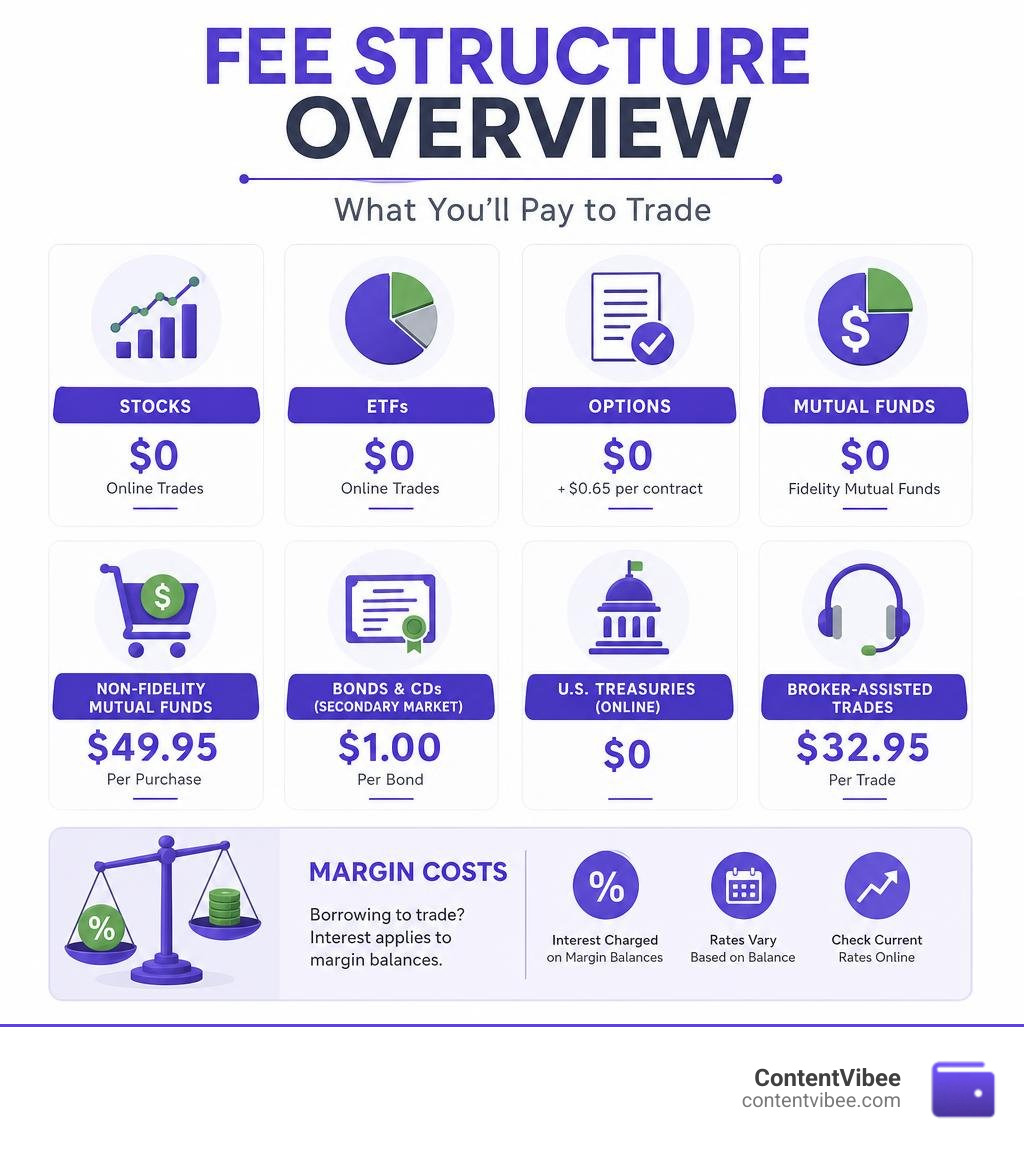
| Trade Type | Online Fee |
|---|---|
| U.S. stocks & ETFs | $0 |
| Options (per trade) | $0 + $0.65 per contract |
| Fidelity mutual funds | $0 |
| Non-Fidelity mutual funds (transaction fee) | $49.95 per purchase |
| Bonds & CDs (secondary market) | $1.00 per bond |
| U.S. Treasuries (online) | $0 |
| Broker-assisted trades | $32.95 per trade |
| Certain ETFs (new June 2026 policy) | $100 per purchase |
The headline is good: most stock and ETF trades at Fidelity cost nothing online. No commission. No account minimum. No annual maintenance fee.
But “free” doesn’t mean zero cost in every situation. Regulatory fees still apply on sell orders. Some ETFs now carry a $100 purchase fee. Margin accounts charge interest. And phone-assisted trades cost up to $32.95.
If you’re a mid-career professional thinking about where to hold your retirement assets — or you’re rolling over a workplace account and want to know what ongoing trading will cost — this guide breaks down every fee you might actually encounter at Fidelity in 2026.
Learn more about fidelity stock trading fees:
Understanding the Core Fidelity Stock Trading Fees
When you open a standard retail brokerage account at Fidelity, the general rule is that you can buy and sell U.S. exchange-listed stocks and exchange-traded funds (ETFs) online without paying a single penny in commissions. Whether you execute one trade or one thousand trades, your commission rate remains flat at $0.00.
This $0 pricing model has become the baseline standard across the retail brokerage industry, but we like to look deeper to see how brokers handle the fine print. To get a complete look at how these zero-commission rules are laid out, you can view the official Fidelity Brokerage and Commission Fee Schedule | Trading information .
It is important to note that this $0 flat-rate model is designed specifically for individual retail investors. If you are classified as a Professional Equity Trader, the fee structure shifts to a per-share model of $0.001 per share instead of the standard $0 flat fee. However, for the vast majority of personal finance DIYers, retirement savers, and long-term investors, the cost to execute standard U.S. equity trades online is completely free of base commissions.
For a comprehensive breakdown of whether there are any hidden catches to these “free” trades, we recommend checking out our detailed guide on Are Fidelity Trades Really Free? Demystifying the Fees.
How Do Fidelity Stock Trading Fees Apply to Fractional Shares?
If you do not have enough cash to buy a full share of a high-priced stock, Fidelity offers a feature called “Stocks by the Slice.” This dollar-based investing tool allows you to buy fractional shares of stocks and ETFs for as little as $1.00.
We are happy to report that this fractional share trading does not carry any extra fees. The same $0 online commission rate applies to your fractional trades. Whether you are buying $5 worth of an expensive tech stock or a full share, the transaction remains commission-free. This makes building a diversified portfolio highly accessible for beginners who want to practice dollar-cost averaging without their returns being eaten away by micro-transaction fees.
If you want to understand the exact mechanics, limits, and operational rules of how this works, read our complete guide on Does Buying Stock Slices Cost Extra? Fidelity Fractional Fees Explained.
Options Trading and Contract Fees
If you want to venture beyond standard stock purchases and trade options, Fidelity’s fee structure changes slightly. While there is still a $0 base commission to open or close an options trade online, you will pay a per-contract fee of $0.65.
This means if you buy 10 options contracts, your total fee for that trade will be $6.50. However, there is one highly investor-friendly exception: if you execute a “buy-to-close” order to close out a short option position valued at $0.65 or less, Fidelity waives the contract fee.
That options trading also carries minor regulatory pass-through charges, such as the Options Regulatory Fee (ORF), which typically ranges from $0.02 to $0.04 per contract. For a deep dive into how these contract fees scale with complex, multi-leg options strategies, explore The Ultimate Guide to Fidelity Option Commissions.
Hidden Costs and Exceptions to Free Trading
While the $0 commission sticker price is real, no brokerage operates in a completely cost-free vacuum. There are minor regulatory and transaction fees that you should keep on your radar.
The most common “hidden” fee is the Additional Assessment fee (often referred to as the SEC fee or SRO fee). This is a tiny regulatory fee mandated by federal law on all security sell orders. It is passed directly from the regulators through the broker to you. Because it only applies to sell orders and amounts to just a few pennies per several thousand dollars of volume, most casual investors barely notice it. To make sure you aren’t surprised when liquidating a position, read our analysis on Don’t Get Caught Off Guard by Stock Selling Fees.
The New $100 Service Fee on Specific ETFs
The most significant recent policy shift at Fidelity involves a new $100 service fee on a specific list of over 120 ETFs.
Historically, ETF issuers have subsidized the operational costs of offering commission-free trading on major platforms by paying asset-based fees to the brokerages. Under a policy that went into effect recently, Fidelity began requiring ETF issuers to pay these maintenance fees. For the select group of ETF sponsors who declined to pay, Fidelity chose to pass those costs directly to the retail investor in the form of a $100 service fee per purchase trade.
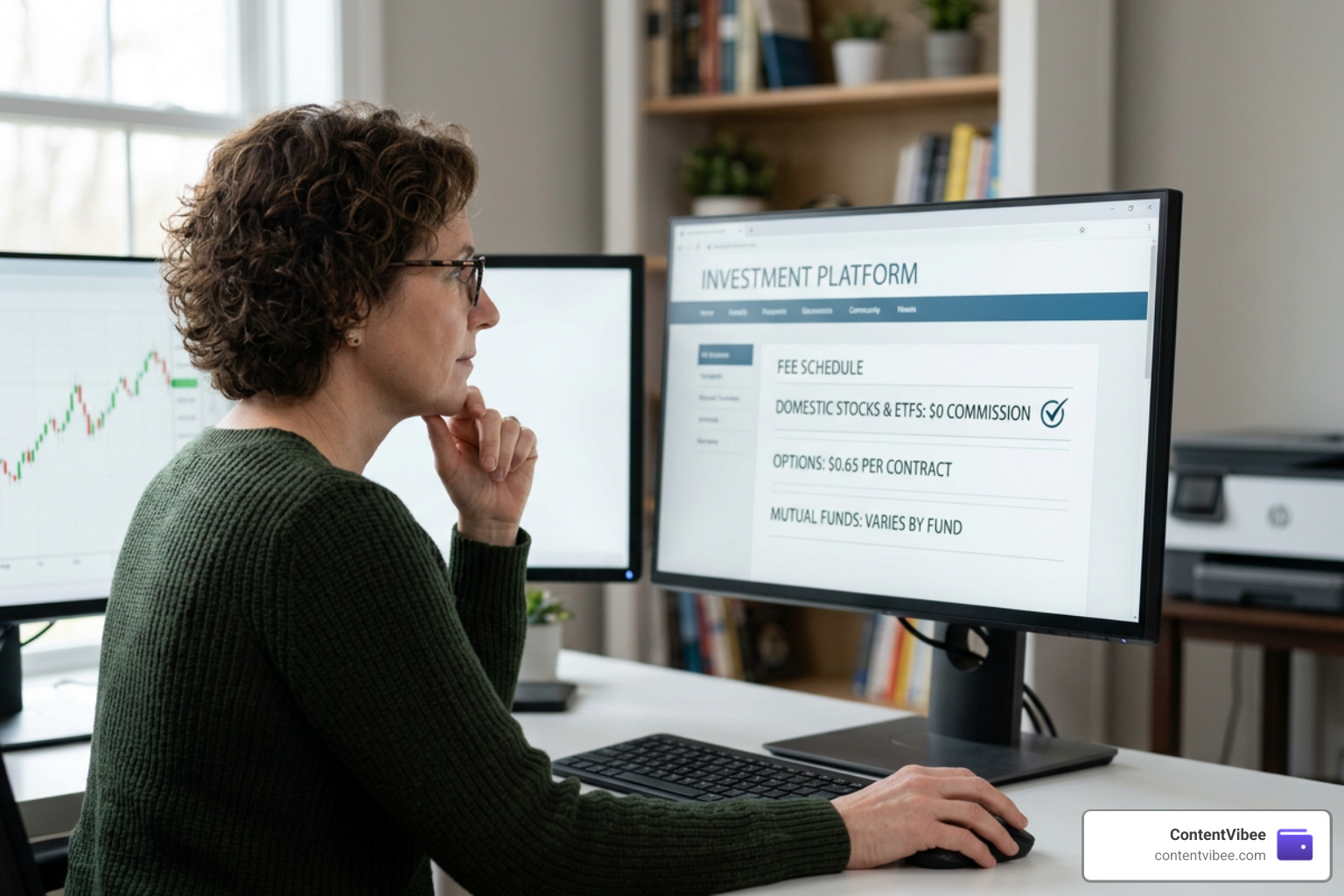
This fee applies to over 120 niche or specialized ETFs, including:
- Roundhill Magnificent Seven ETF (which holds over $4.4 billion in assets)
- Roundhill Generative AI & Technology ETF ($1.3 billion in assets)
- Dan Ives Wedbush AI Revolution ETF ($1.0 billion in assets)
This policy has a massive impact on retail investors. For example, if you wanted to buy a single share of the Magnificent Seven ETF (which trades around $66 per share), the $100 purchase fee would actually exceed the cost of the stock itself! If you frequently trade these specific specialized or covered-call ETFs, you may want to look closely at the fee disclosures or consider alternative holding strategies.
Are There Hidden Fidelity Stock Trading Fees for International Equities?
For investors looking to diversify globally, Fidelity offers the ability to trade directly in 25 countries and transact in 16 different currencies. However, trading foreign stocks directly on foreign exchanges is not free.
When you trade directly on an international exchange, you will face transaction fees that vary by country, alongside currency exchange fees that can run up to 1.00% of the total transaction value. Additionally, if you trade foreign ordinary stocks that are not eligible for the Depository Trust Company (DTC), Fidelity charges a foreign settlement fee of up to $50 per trade.
To navigate the difference between trading local shares abroad versus buying dollarized American Depositary Receipts (ADRs) on U.S. exchanges, check out our step-by-step breakdown: A Step-by-Step Guide to Fidelity Share Dealing Fees and Commissions.
Margin Rates and Other Account Service Fees
If you want to borrow money against your existing securities to trade on leverage, you will need to apply for a margin account. Margin trading is highly risky, and the interest rates charged on your borrowed balance can significantly impact your overall returns.
Fidelity determines its margin interest rate by combining a “base rate” with a premium or discount depending on your debit balance. Larger debit balances receive much more favorable rates. As of December 12, 2025, Fidelity’s base margin rate was set at 10.575%.
To see how these rates compare and plan your leverage costs, refer to the official Trading Commissions and Margin Rates | Fidelity resource.
Tiered Margin Interest Rates in 2026
Below is the tiered margin interest rate schedule based on your outstanding debit balance:
| Margin Debit Balance | Effective Interest Rate |
|---|---|
| $0 to $24,999 | 11.825% |
| $25,000 to $49,999 | 11.325% |
| $50,000 to $99,999 | 10.825% |
| $100,000 to $499,999 | 10.325% |
| $500,000 to $999,999 | 8.000% |
| $1,000,000+ | 7.500% |
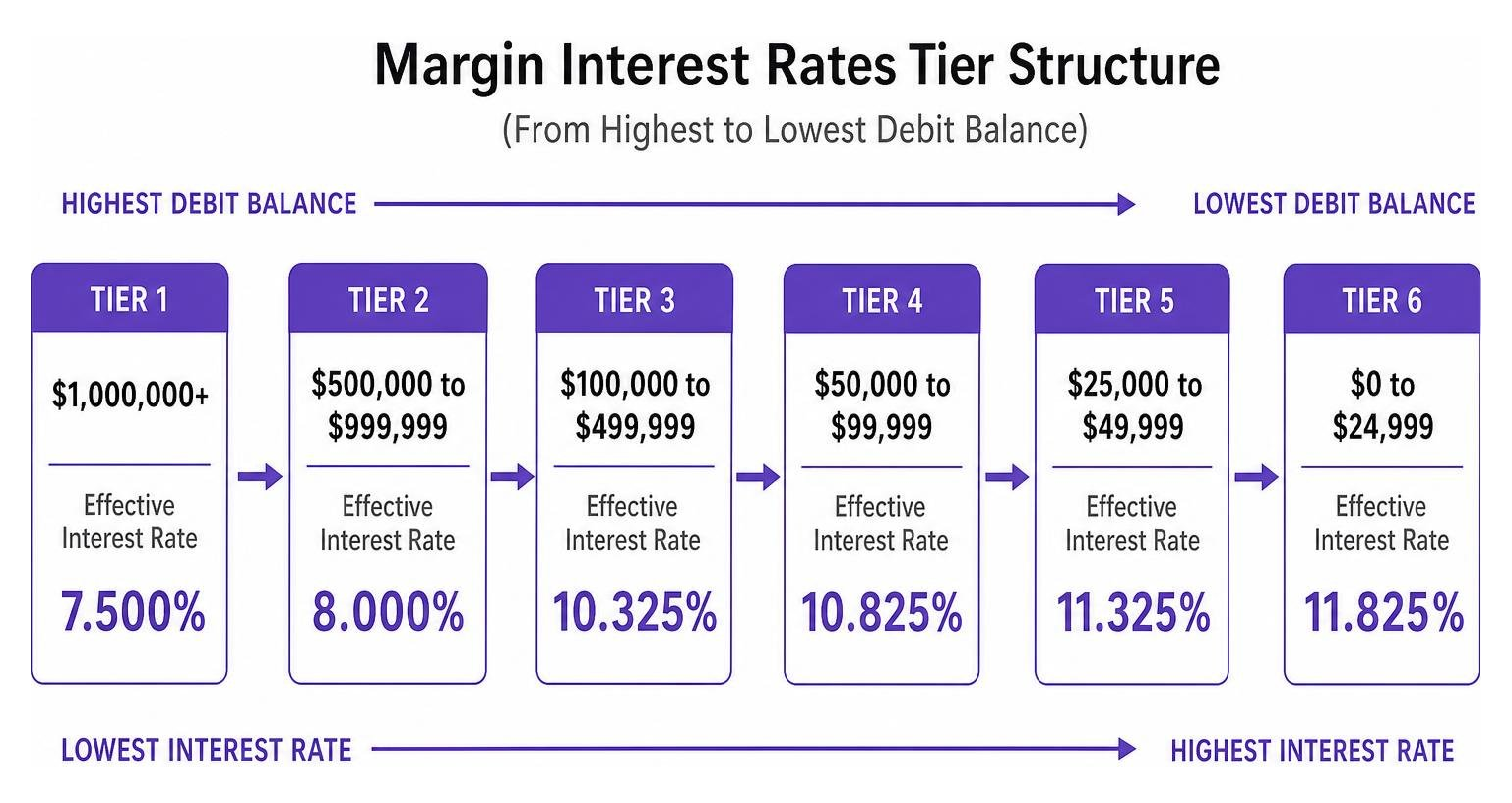
As the diagram illustrates, borrowing smaller amounts (under $25,000) is relatively expensive at 11.825%, while wealthy investors borrowing over $1 million enjoy a much lower rate of 7.50%. When compared to competitors like Vanguard or Charles Schwab, Fidelity’s margin rates are highly competitive, particularly at the upper tiers.
Broker-Assisted Trades and Phone Commissions
It is easy to forget that the $0 commission rate is exclusively an online trading rate. If you prefer to place your trades over the phone, you will pay for the operational support:
- FAST (Fidelity Automated Service Telephone): Placing a stock or ETF trade through the automated phone system costs $12.95 per trade.
- Representative-Assisted Trades: If you want to speak directly to a live broker to execute a trade for you, the service charge is $32.95 per trade.
These fees can quickly erode your returns, especially on smaller account balances. To learn how to avoid these manual fees entirely, read our guide on the Broker-Assisted Trade Fee Fidelity.
Frequently Asked Questions about Fidelity Accounts
Is there an annual fee for a Fidelity brokerage account?
No. Fidelity does not charge any annual account fees, account maintenance fees, or inactivity fees for its standard retail brokerage accounts or IRAs. There is also a $0 minimum deposit requirement to open an account.
This stands in stark contrast to some competitors. For example, Vanguard charges a $20 annual account service fee for certain accounts (unless specific paperless or asset thresholds are met), and Schwab charges a $50 fee for full outbound account transfers, while Fidelity charges $0 for outbound transfers. You can read more about these transparent structural advantages in the official guide to Straightforward and Transparent Pricing – Fidelity .
What is the short-term redemption fee for mutual funds?
While buying and selling Fidelity’s own brand of mutual funds is completely free ($0 transaction fee), buying non-Fidelity funds can sometimes cost money.
For non-Fidelity transaction-fee funds, you will pay a flat $49.95 purchase fee online.
For No-Transaction-Fee (NTF) non-Fidelity funds, there is no fee to purchase the fund. However, to prevent short-term trading and protect fund liquidity, Fidelity enforces a $49.95 short-term redemption fee if you sell or exchange shares of an NTF fund that you have held for less than 60 days. To learn how to structure your fund holdings to avoid these penalties, check out our analysis: Fidelity Mutual Fund Trade Fee: When Is Free Not Actually Free?.
How does the core position earn interest?
One of Fidelity’s standout features is its automatic “core position.” When you open an account, any uninvested cash is automatically swept into a default core position, such as the Fidelity Government Money Market Fund (SPAXX).
Unlike other brokerages that sweep your idle cash into low-yield bank accounts paying 0.01% to 0.45%, Fidelity’s core money market position sweeps your cash into a fund that yields a highly competitive market rate. You do not have to purchase shares manually; the cash is automatically swept, liquidates automatically when you buy stocks, and continues to earn interest daily.
Conclusion
Fidelity remains one of the most cost-effective, high-value brokerages in the industry for retail investors. By offering $0 online commissions on U.S. stocks, ETFs, and options, alongside a high-yielding automatic cash sweep and zero account maintenance fees, they make it easy to keep your investment expenses to an absolute minimum.
However, as we have shown, staying fee-free requires a little bit of strategic planning. By avoiding broker-assisted phone trades, holding NTF mutual funds for at least 60 days, and staying clear of the newly restricted list of $100-fee ETFs, you can successfully trade on Fidelity without ever paying a single dime in unnecessary fees.
At ContentVibee, our goal is to deliver clear, actionable, step-by-step financial advice to help you manage your retirement and maximize your savings. For more strategies on how to optimize your portfolio and cut down on investment costs, read The Ultimate Guide to Fidelity Trading Fees and Savings.