


What It Means to Roll a 403b Into a 401k (And Whether You Should)
If you’re looking to roll a 403b into a 401k, here’s the short answer: yes, you can — and in many cases, it’s a smart move.
How to roll a 403(b) into a 401(k) in 5 steps:
- Confirm your new 401(k) plan accepts incoming rollovers
- Contact your 403(b) plan administrator to request a distribution
- Choose a direct rollover (trustee-to-trustee) to avoid taxes and penalties
- Provide your new 401(k) plan’s details to your 403(b) provider
- Verify the funds arrive and update your investment allocations
Careers rarely move in a straight line. If you’ve gone from a school, hospital, or nonprofit into a private-sector role, you’ve also moved from 403(b) plans into 401(k) plans — and your old retirement account doesn’t automatically follow you.
Right now, there’s an estimated $1.26 trillion sitting in 403(b) plans nationwide, compared to over $8.7 trillion in 401(k) plans. That gap reflects something real: 401(k) plans tend to offer more investment options, lower fees, and more generous employer matching.
But moving your money isn’t as simple as clicking a button. Get it wrong — miss a deadline, skip a form, or choose the wrong rollover method — and you could trigger a tax bill plus a 10% early withdrawal penalty.
This guide walks you through everything: the IRS rules, the exact steps, the tax implications, and the common mistakes that trip people up.
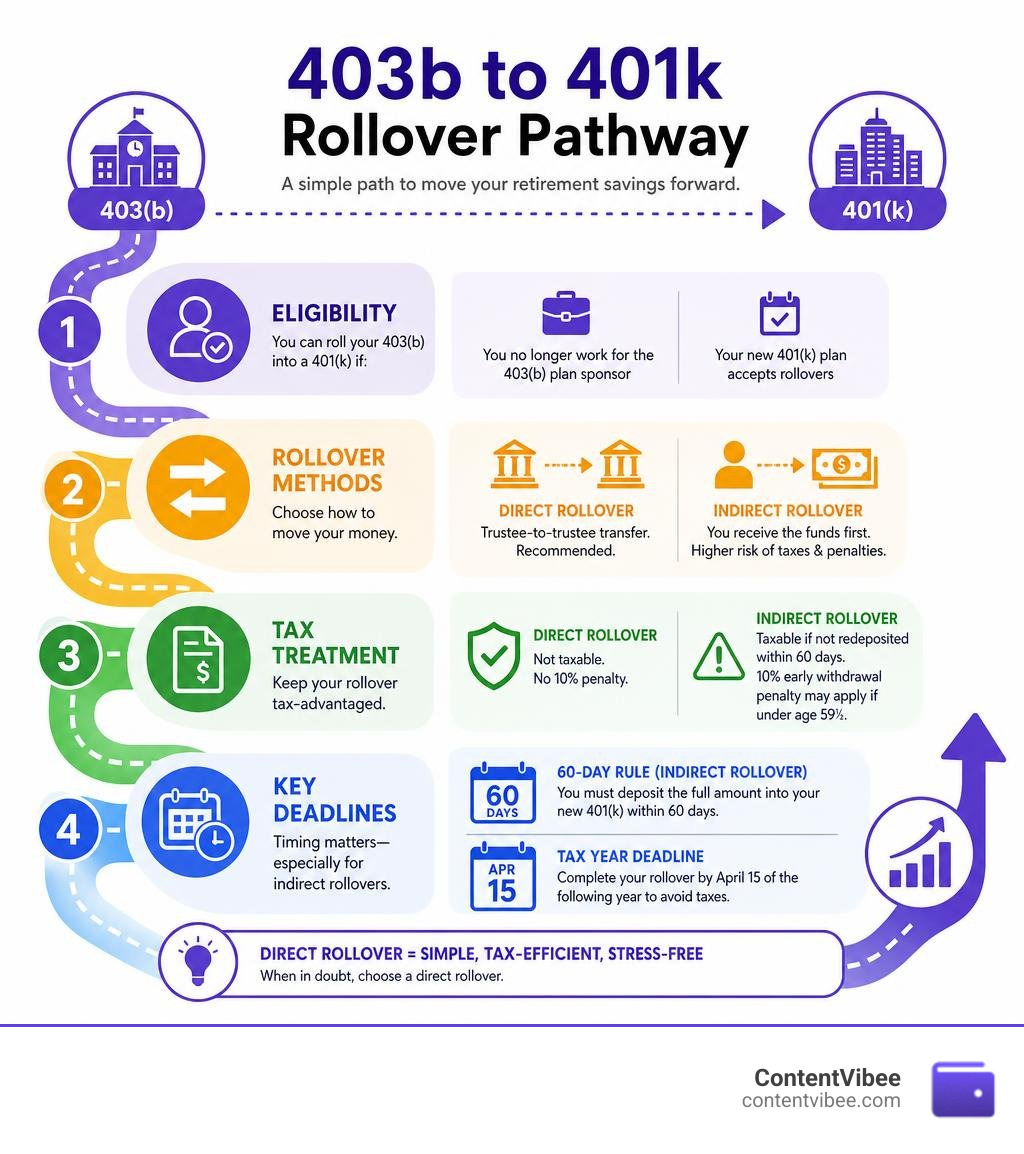
Why and How to Roll 403b Into 401k Accounts

When you leave an employer, your old retirement account usually stays with your former employer’s plan provider unless you take action. Leaving it behind can lead to lost statements, outdated contact information, limited investment choices, and a general lack of financial clarity. It is the financial equivalent of a “junk drawer” where old accounts go to rest.
Consolidating your accounts simplifies your life. Instead of managing multiple logins, tracking different fee structures, and trying to balance asset allocations across three different platforms, you can bring everything under one roof.
Furthermore, 401(k) plans often hold massive pricing leverage. Because 401(k) plans collectively hold over $8.7 trillion, plan sponsors have the scale to negotiate institutional-class shares with incredibly low expense ratios. Many older 403(b) plans, particularly those built in the 1980s and 1990s, are notorious for being packed with expensive variable annuities and mutual funds carrying sales loads or administrative fees that quietly eat away at your returns. Moving those funds into a low-cost, modern 401(k) plan can easily save you thousands of dollars in compounding fees over a 20-year career.
If you are looking to optimize your broader financial picture, consolidating your accounts is a core pillar of the ultimate guide to retirement money management.
IRS Rules to Roll 403b Into 401k Plans
The Internal Revenue Service (IRS) explicitly permits you to roll a 403b into a 401k plan, but there is a major catch: your new employer’s plan must allow incoming rollovers. While the IRS permits these transfers, employers are not legally required to accept them.
Before making any moves, you must confirm with your new HR department or plan administrator that their 401(k) plan accepts rolled-over assets from a 403(b).
It is also important to know that rolling over existing retirement funds does not count toward your annual contribution limits. For the current year of 2026, the maximum employee deferral limit for a 401(k) is $24,500. If you are age 50 or older, you can take advantage of catch-up contributions, which bring your individual limit even higher.
You can read all about these updated figures in our comprehensive breakdowns: the new 2026 maximum 401k contribution limits explained and the complete guide to retirement contribution catch up limits.
Because rollovers are categorized as transfers rather than new contributions, you can roll over a $100,000 or $500,000 balance into your new 401(k) in 2026 without affecting your ability to contribute your normal $24,500 paycheck deferrals for the year.
Plan-Specific Restrictions and Eligibility
Even if your new 401(k) plan accepts rollovers, your old 403(b) plan must release the funds. Your eligibility to move your 403(b) funds depends entirely on your current employment status and the specific rules outlined in your old plan’s document.
Generally, you are eligible to roll over your 403(b) if you meet one of the following “triggering events”:
- You have terminated employment with the employer who sponsored the 403(b) plan.
- You have reached age 59½.
- You have become permanently disabled.
If you are still actively employed by the organization sponsoring your 403(b) plan, you generally cannot roll those funds into a new 401(k) unless your plan allows for “in-service distributions.” In-service distributions are highly plan-specific and usually restricted to employees who have reached age 59½ or met strict vesting requirements.
To map out how your ongoing contributions fit into your savings strategy, check out the ultimate guide to calculating your 401k contributions.
The Step-by-Step Rollover Guide

Executing a rollover requires coordination between you, your old plan administrator, and your new plan custodian. To ensure nothing gets lost in transit, we have compiled a master checklist of the exact steps you need to take.
If you want a broader look at moving these accounts to other destinations, you can also read our 403b rollover guide master your retirement account move.
Step-by-Step Process to Roll 403b Into 401k Successfully
Follow this sequence to ensure your rollover is executed smoothly, safely, and without triggering unnecessary taxes:
Step 1: Contact Your New 401(k) Plan Administrator
Before doing anything else, call your current 401(k) provider. Ask them:
- “Do you accept incoming rollovers from a traditional pre-tax 403(b)?”
- “Do you accept Roth 403(b) rollovers?”
- “What is the exact name, address, and account number that must be written on the check?” (This is critical: if the check is made out to the wrong entity, it will be rejected).
Step 2: Contact Your Old 403(b) Plan Administrator
Reach out to the provider holding your old 403(b) funds. Request a full account breakdown. You need to know exactly how much of your balance consists of pre-tax contributions, after-tax (Roth) contributions, and employer-matching funds. Ask them for their “distribution request” or “rollover initiation” paperwork.
Step 3: Select the Direct Rollover Option
When filling out the paperwork, you will be asked to choose between a direct and an indirect rollover. Always choose a direct rollover (trustee-to-trustee transfer). This tells your old provider to send the funds directly to your new 401(k) custodian, completely bypassing your personal bank account and avoiding automatic tax withholding.
Step 4: Submit the Paperwork and Track the Check
If your old provider does not support electronic transfers, they will physically mail a paper check. In many cases, they will mail this check directly to you, but it will be made payable to your new 401(k) custodian for your benefit (e.g., “New Custodian FBO [Your Name]”). Once you receive this check in the mail, do not deposit it into your personal bank account. Forward it immediately to your new 401(k) custodian along with any required deposit forms.
Step 5: Log In and Invest Your Funds
Once your new 401(k) provider receives and processes the check, the funds will appear in your account. They will sit in a default cash or money market fund until you take action. You must log in to your portal and manually select how to invest this money according to your chosen asset allocation.
If you have recently left your job and are wondering about the timeline for this entire process, our guide on how long do you have to rollover a 401k after quitting offers excellent timelines and administrative deadlines to keep in mind.
Required Documentation and Forms
To complete this process, you will need to handle several key pieces of documentation:
- Distribution Request Form: Completed with your old 403(b) provider to release the funds.
- Letter of Acceptance (LOA): Some old plan providers require a formal letter from your new 401(k) custodian confirming that the new plan is qualified and will accept the incoming funds.
- Form 1099-R: In the tax year following your rollover, your old 403(b) provider will issue this form. It reports the distribution to the IRS. Box 7 will feature a specific code (usually “G” for a direct rollover), which tells the IRS the move was tax-free.
- Form 5498: Your new 401(k) provider (or IRA custodian, if applicable) will file this form to report the receipt of the rolled-over funds, matching the 1099-R and proving to the IRS that the money was successfully redeposited.
Tax Implications, Penalties, and Contribution Types
Understanding the tax treatment of your rollover is essential to avoiding costly mistakes. If you are debating the long-term tax advantages of different account structures, we recommend reviewing the great retirement debate roth vs traditional 401k calculator guide.
Direct vs. Indirect Rollovers
The absolute easiest way to trigger an accidental tax bill is by choosing an indirect rollover instead of a direct rollover.
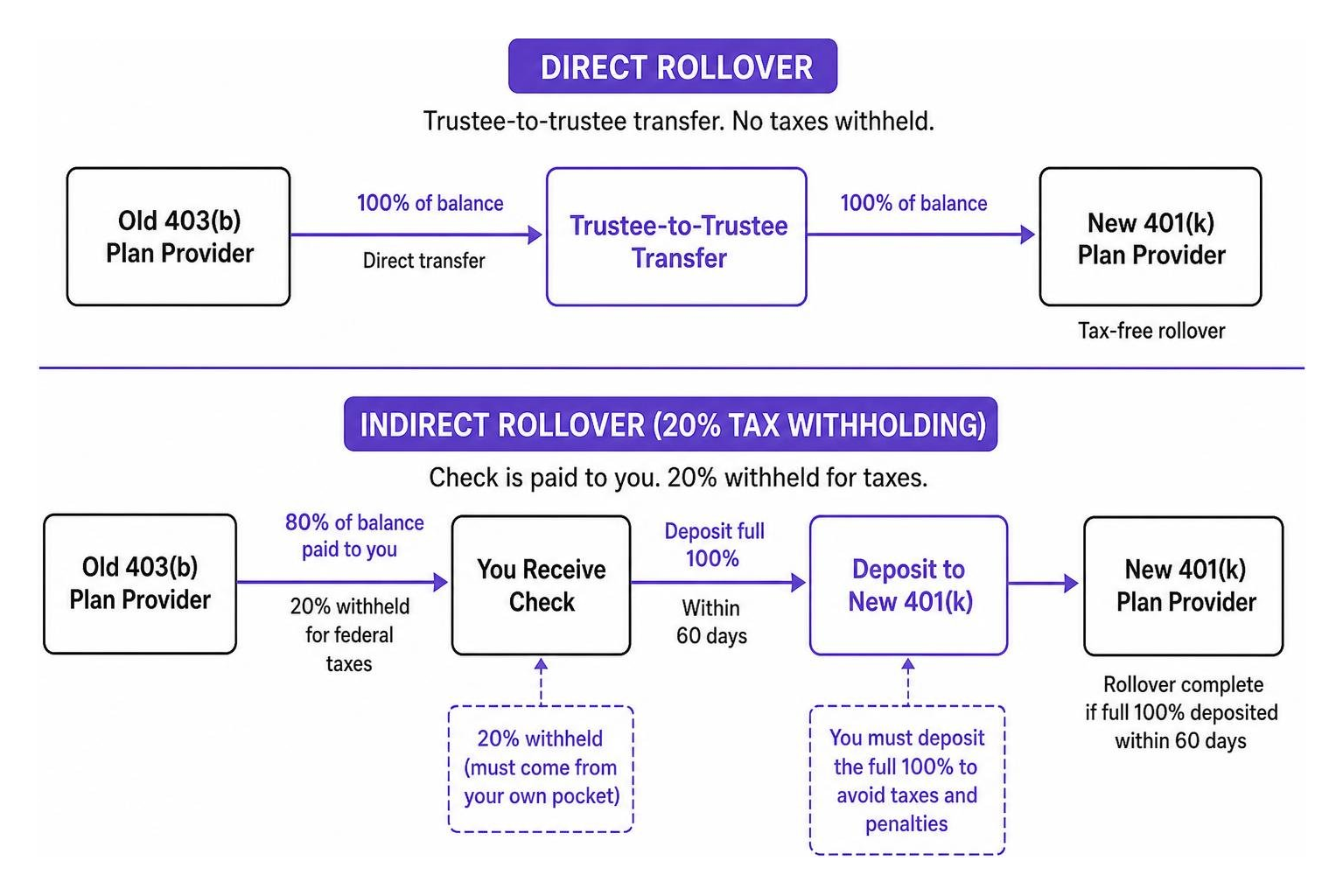
In a direct rollover, the money moves directly from trustee to trustee. No taxes are withheld, and the IRS does not view this as a taxable event.
In an indirect rollover, the old plan administrator writes a check made payable directly to you. By law, the administrator must withhold 20% of the balance for federal income taxes.
To complete the rollover and keep the entire transaction tax-free, you must deposit the full 100% of the original balance into your new 401(k) within 60 days. This means you must come up with the missing 20% out of your own pocket to bridge the gap.
Here is a diagram illustrating how this works:
Consider this real-world example:
River requests an indirect rollover of their $10,000 403(b) balance. The administrator withholds 20% ($2,000) for federal taxes and mails River a check for $8,000.
To avoid taxes and penalties, River must deposit the full $10,000 into their new 401(k) within 60 days. This means River must find $2,000 of personal cash to add to the $8,000 check.
If River fails to deposit the full $10,000 within 60 days, the missing amount is treated as a taxable distribution. River will owe ordinary income taxes on the $2,000, plus a 10% early withdrawal penalty ($200) if they are under age 59½.
For a complete breakdown of eligible rollover pathways, you can consult the official IRS Rollover Chart.
Pre-Tax vs. Roth (After-Tax) Contributions
If your 403(b) plan contains a mix of pre-tax and after-tax (Roth) contributions, you must handle them with extreme care.
- Pre-Tax 403(b) Funds: These must be rolled into a traditional pre-tax 401(k) to remain tax-deferred.
- Roth (After-Tax) 403(b) Funds: These must be rolled into a Roth 401(k) or a Roth IRA. They cannot be rolled into a traditional pre-tax 401(k).
Under IRS Notice 2014-54, you are allowed to split your rollover in a single transaction. You can direct your pre-tax assets to a traditional pre-tax account and your after-tax assets to a Roth account simultaneously.
If you are considering moving your funds into an IRA instead of a 401(k), you might want to read our detailed guides on can you move your 403b to a roth ira and the ultimate guide to converting your 403b to a roth ira.
Comparing Your Options: 401(k) vs. IRA Rollover
When you leave a job, rolling your 403(b) into your new employer’s 401(k) is not your only option. You can also roll it into an Individual Retirement Account (IRA). Here is a direct comparison of how these two options stack up:
| Feature | 401(k) Rollover | IRA Rollover |
|---|---|---|
| Investment Selection | Limited to the plan’s curated menu | Virtually unlimited (stocks, ETFs, mutual funds) |
| Creditor Protection | Unlimited federal protection under ERISA | Protected up to ~$1.5 million in bankruptcy |
| Plan Loan Options | Often allowed (up to $50,000 or 50% of balance) | Strictly prohibited |
| Rule of 55 Eligibility | Yes (if you leave your job at age 55 or older) | No (must wait until age 59½ to avoid 10% penalty) |
| RMD Rules | Waived if you are still actively working there | Mandatory starting at age 73 or 75 |
Pros and Cons of a 401(k) Rollover
Rolling your 403(b) into a 401(k) comes with several distinct advantages:
- ERISA Creditor Protection: Qualified 401(k) plans are protected by federal law (ERISA) from almost all lawsuits, bankruptcy proceedings, and debt collection efforts. IRAs, on the other hand, rely heavily on state-specific laws for protection, which can vary wildly.
- The Rule of 55: If you leave or lose your job in or after the calendar year you turn 55, the IRS allows you to take penalty-free withdrawals from your active 401(k) plan. This rule does not apply to IRAs, where you must wait until age 59½ to avoid the 10% early withdrawal penalty.
- Loan Provisions: Many 401(k) plans allow participants to take out loans against their balance. You cannot take a loan from an IRA under any circumstances.
However, the main downside of a 401(k) rollover is that your investment choices are limited to whatever menu your employer’s plan provider offers. If you prefer to manage your own portfolio using individual stocks or specific ETFs, an IRA might suit you better.
If you lean toward the IRA route, check out our guide on the ultimate guide to your 2026 max roth ira contribution.
Special Considerations: Loans, RMDs, and Creditor Protection
Before initiating a transfer, you must account for outstanding plan loans and Required Minimum Distributions (RMDs).
If you have an outstanding loan on your 403(b) and leave your employer, you generally cannot roll that loan over. You must either pay off the loan balance in full or face a “loan offset.” A loan offset means the unpaid balance is treated as a taxable distribution, which will be subject to ordinary income taxes and potentially a 10% early withdrawal penalty.
Under the SECURE Act, if your loan offset is categorized as a Qualified Plan Loan Offset (QPLO), you have until the tax filing deadline (including extensions) for the year of the offset to deposit the missing funds into an eligible retirement plan to avoid taxes and penalties.
For older savers, RMDs must be taken before any rollover occurs. The IRS does not allow you to roll over an RMD; you must take your required distribution first, pay taxes on it, and then roll over the remaining balance.
Frequently Asked Questions about 403(b) to 401(k) Rollovers
Can I roll over my 403(b) while still employed?
Generally, no. Most 403(b) plans do not allow you to move your funds while you are still actively working for the sponsoring employer. However, some plans allow “in-service transfers” if you have reached age 59½ or met specific vesting guidelines defined in your employer’s plan document. You will need to contact your HR department or review your Summary Plan Description (SPD) to confirm your plan’s rules.
What happens to my outstanding 403(b) loan during a rollover?
If you leave your job with an outstanding 403(b) loan, you must either repay the loan balance immediately or the unpaid portion will be treated as a taxable distribution (a loan offset). If it is treated as a Qualified Plan Loan Offset (QPLO), you have until your tax return due date (plus extensions) to deposit the offset amount into your new 401(k) or IRA to keep the transaction tax-free.
Is there a limit to how much I can roll over?
No. There is no dollar limit on the amount you can transfer during a rollover. Whether your 403(b) balance is $5,000 or $5,000,000, you can roll the entire amount into a new 401(k) plan without affecting your annual contribution limits.
Conclusion
Taking control of your retirement accounts is one of the most powerful steps you can take toward securing your financial future. When you roll a 403b into a 401k, you simplify your portfolio, potentially reduce your fees, and put yourself back in the driver’s seat of your financial destiny.
At ContentVibee, we are dedicated to providing clear, actionable financial guidance to help you navigate these transitions with confidence.
As you organize your household retirement strategy, don’t forget that planning is a team sport. Take a moment to Calculate Spouse Retirement Benefits to ensure you and your partner are perfectly aligned for the road ahead!